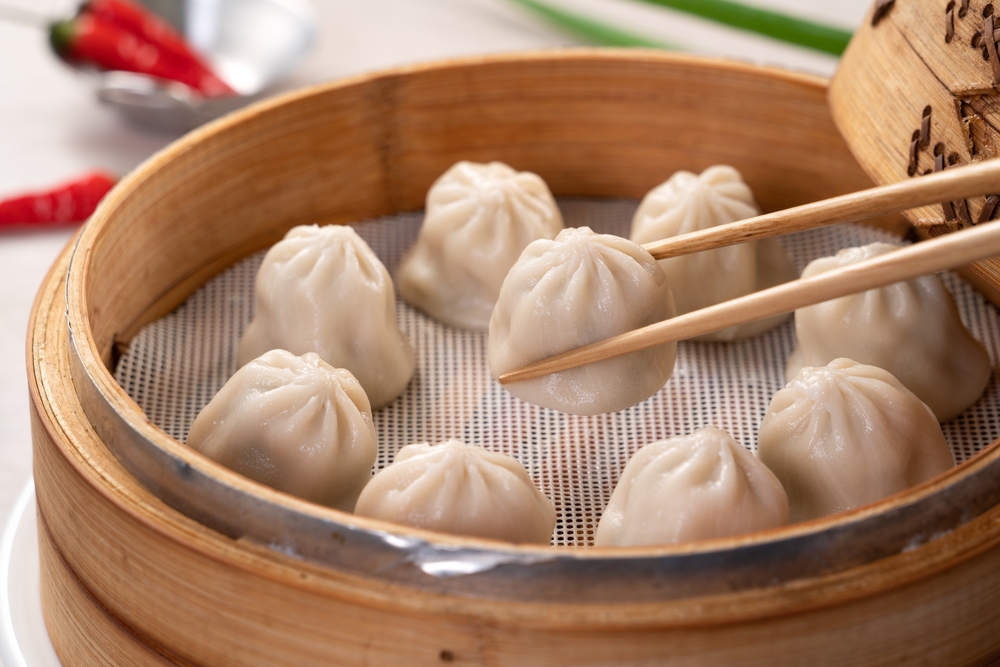
Your essential guide to beating the crowds at Chinatown’s best restaurants!
Introduction: The Chinatown Dining Strategy
I’ll be honest: NYC’s Chinatown has officially entered its “Viral Era.” It seems like every legendary spot now has a 40-person line snaking down the block, turning a quick lunch into a two-hour ordeal. But you don’t have to spend your entire afternoon on a sidewalk to get the city’s most iconic soup dumplings or pork buns.
This guide is a procedural roadmap designed to help you navigate the five NYC Chinatown best restaurants without the soul-crushing wait. After visiting Chinatown myself over the years, I’ve found that beating the crowds is all about how you time your arrival and which door you walk through. Whether you’re craving the old-school charm of Wo Hop or the famous broth at Joe’s Shanghai, I’ve broken down the exact entry strategy for each spot so you–not the line–stay in total control of your itinerary.
If you’re still deciding on your NYC food tour, make sure to read my Decision Matrix at the end of this post, and check my NYC subway guide to see which lines will drop you off closest to Chinatown’s best restaurants!
Chinatown No-Wait Strategy Table
| Restaurant | The “No-Wait” Procedure | Pro-Tip |
| Wo Hop | Go Upstairs (15 Mott Street) | The downstairs is iconic, but the upstairs serves the same food with half the wait. |
| Mei Lai Wah | Use the Digital Kiosk | Most tourists stand in the cash line; the kiosk in the corner is often empty. |
| Shanghai 21 | The “Mid-Afternoon” Gap | Aim to visit between 3:30pm–4:30pm on a weekday for immediate seating. |
| Deluxe Green Bo | The “Small Group” Rule | Parties of 2 are seated 3x faster than groups of 4+ due to table layout. |
| Joe’s Shanghai | The “Bowery Front” Hack | Don’t wait at the Pell Street entrance; enter through the Bowery entrance for the real line/queue status. |
Map
I’ve pinned all 5 restaurants in this map to help you navigate your way to the restaurant(s) you want to eat at.
How to Use & Save This Map
To make your trip around Chinatown even easier, you can save this custom map directly to your Google Maps app:
- Open the Map: Click the [ ] icon in the top right corner of the map above to open it in full-screen mode.
- Save to Your Account: If you are signed into your Google account, the map will automatically be saved to your “Your Places” or “Saved” list.
- Access on the Go: On your phone, open the Google Maps app, tap the “Saved” (or “You”) tab at the bottom, scroll down to “Maps,” and select “5 NYC Chinatown Best Restaurants” to see all these pins while you’re walking!
- Pro-Tip: If you have limited data or a spotty connection, you can download the “Chinatown” area for offline use in your Google Maps settings so you never lose your way.
Timing Alert: The Lunar New Year Factor 🧧
If you are using the map above to plan your Chinatown visit, check your calendar! During Lunar New Year, Manhattan’s Chinatown becomes the most densely packed square mile in NYC.
- 2027 Key Date: Saturday, February 6, 2027 (The Year of the Goat).
- The Reality: The “30-minute crawl” becomes impossible. Sidewalks are standing-room only, and wait times for spots like Mei Lai Wah can jump from 5 minutes to over an hour.
- The Expert Strategy: If you aren’t visiting specifically for the parade or firecrackers, avoid the neighborhood during the peak festival weekends. If you must go, arrive by 10:00am sharp. By 1:00pm, the pedestrian gridlock makes it nearly impossible to move between stops.
Know Before You Go: Pro-Warnings ⚠️
Tip for all of these restaurants: Some of the older spots provide limited napkins, so keeping a pack of tissues in your bag is a pro move.
Wo Hop and Shanghai 21
⚠️ Cash is King: Despite new 2026 laws requiring NYC businesses to accept cash, these “old school” spots only take cash. Keep $40–$60 in small bills (which I talk more about below) on you to avoid being “that person” stuck at the table with only a credit card.
Mei Lai Wah
⚠️ The Kiosk “Ghost” Inventory: The card kiosks in the back don’t always sync with the kitchen. You might pay for a bun only to find out they just sold the last one to a cash customer. Ask the staff if what you want is in stock before you tap your card at the kiosk.
⚠️ Line Confusion: There are two lines–one for the sit-down counter and one for bakery take-out. If you just want the famous pork buns, join the faster take-out line on the left.
Deluxe Green Bo
⚠️ The “Rice is Extra” Rule: Unlike most Chinese restaurants, entrees here often do not come with rice. Budget an extra ~$3 for a side of white rice if you’re ordering a main dish.
⚠️ Tipping Pressure: Servers have been known to be very “vocal” if they feel a tip is too small. Standard NYC tipping is 18–20%. Stay firm on your math even if they seem rushed or pushy.
Joe’s Shanghai
⚠️ The 18% Tip Trap: They automatically add an 18% service charge to every bill. Always check your receipt before adding a tip so you don’t pay twice.
⚠️ ATM Surcharges: This is a cash-only spot. Their internal ATM has high fees. Stop at the Chase or TD Bank ATM on Canal Street before you arrive to save $4 in fees.
The “B” Grade Secret
Don’t let the window signs fool you! In NYC’s Chinatown, a “B” or “C” grade is often a badge of culinary authenticity. Here is why you shouldn’t skip a spot just because of a letter:
- Traditional vs. Technical: NYC health codes were written for Western kitchens. Traditional methods–like hanging roast ducks at room temperature to get that perfect crispy skin–earn automatic points off, even if the food is delicious and safe to eat.
- Historic Buildings: Many of these legendary spots (like Wo Hop) are in 100-year-old buildings. Points are often deducted for “infrastructure issues” (like a misplaced sink or a drafty door) that the owners can’t easily change in a historic basement.
- The “A” is often Administrative: Earning an “A” usually requires a dedicated office staff to handle paperwork and legal appeals. Most Chinatown eateries prioritize the food over the paperwork.
The Verdict: If the place is packed with locals and the food is coming out piping hot, you’re in the right place. Trust the crowd over the letter grade!
Visualizing the Grading System
| Grade | Points | Why it happens in Chinatown |
| A | 0–13 | Modern infrastructure and strict code-compliance. |
| B | 14–27 | Often due to “holding temperatures” for traditional roasted meats. |
| C | 28+ | Usually, “General Violations” are related to old building layouts. |
How to Read Chinatown Reviews
Before you check Yelp/Tripadvisor/Google reviews of Chinatown restaurants, remember the “Chinatown Grading Curve”:
- Ignore Service Complaints: A 1-star review about “curt waiters” is usually a 5-star review for authenticity. If a review says the service was ‘curt’ or ‘rude,’ that usually means the food is authentic and the kitchen is fast. In Chinatown, speed is the love language.
- Look for “The Dish”: If 50 people say the “Pork Soup Dumplings” are amazing but the service is “blah,” ignore the service and order the dumplings. Chinatown is a collection of very specific regional cuisines that each restaurant specializes in.
- The 3.5-Star Rule: Some of the best, most traditional food in the city sits at a 3.5-star rating because they don’t play the “customer is always right” game. They play the “the food is always right” game.
- Tourist Trap” vs. “Time Capsule”: Places like Wo Hop get a lot of hate from “food snobs” who think they are too popular or “for tourists.” These places are icons for a reason (I talk more about this below). Wo Hop has been around since 1938; it is a “time capsule” of NYC history.
How to Eat at the Best Chinatown Restaurants Without the Wait
Wo Hop (17 Mott St vs. 15 Mott St)
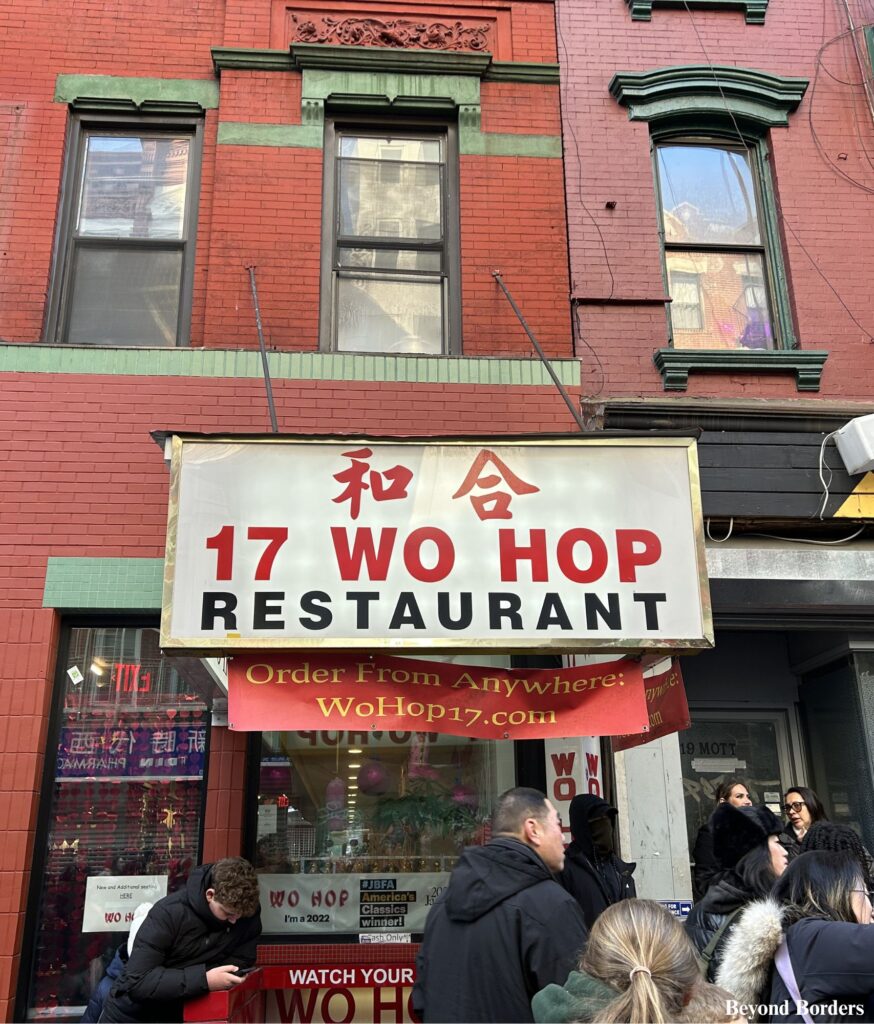
If you want to feel like you’ve stepped back in time, you head to the basement of Wo Hop, founded in 1938. This is the quintessential “old-school” New York experience–fluorescent lights, walls plastered with celebrity photos, and some of the best Cantonese-American comfort food in the country, most famous for their Roast Pork Egg Foo Young (a thick, savory omelet packed with roast pork and smothered in a rich, dark gravy) and their Shrimp in Lobster Sauce (not actually made with lobster, but a traditional savory white sauce with minced pork, garlic, and egg).
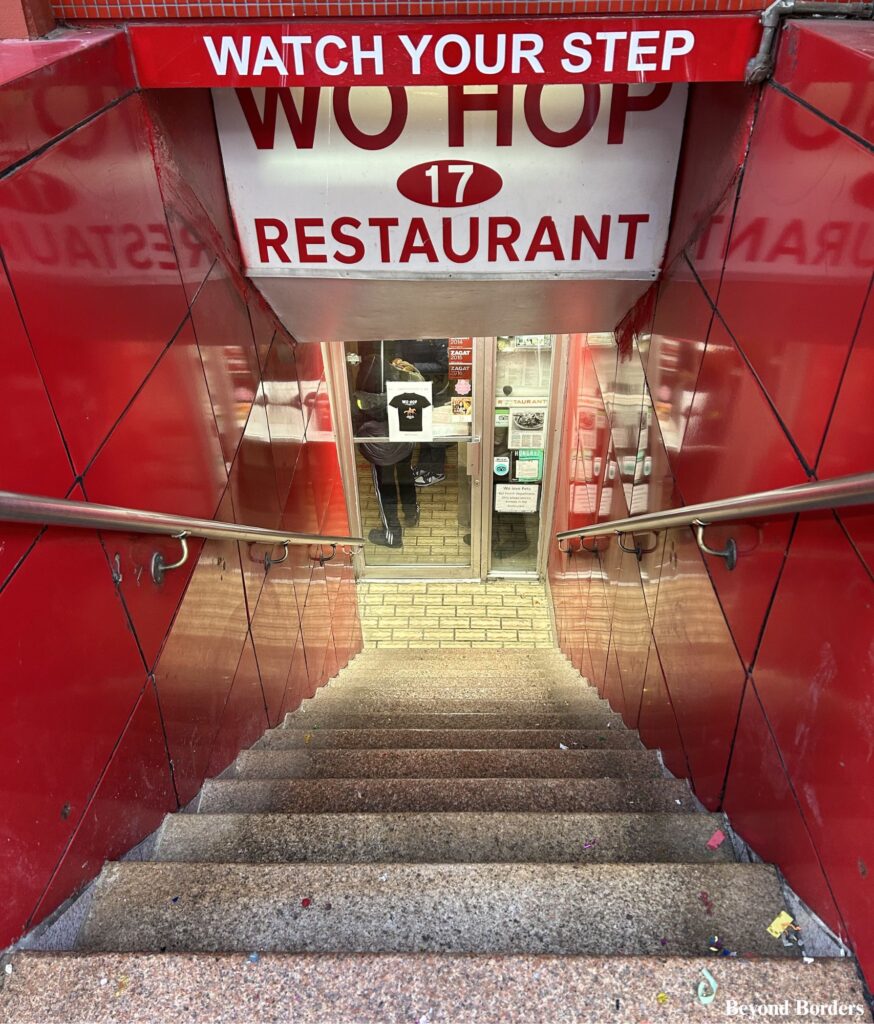
While they recently expanded to include a more modern upstairs dining room, the real “insider” move is still descending those steep concrete stairs for a plate of their legendary ginger and scallion lo mein. It’s loud, it’s fast, and it’s a non-negotiable rite of passage for any NYC foodie. To see their full menu, visit their official website.
The Procedure: Choose your level wisely!
Step-by-Step:
- Check the line at 17 Mott St (Downstairs) first. If it’s more than 10 people, walk two doors down to 15 Mott St (Upstairs).
- This “Expansion” location is often overlooked by tourists following old guidebooks.
- Pro-Tips: If you’re there after 10pm, the downstairs is the only option, but the line moves 2x faster as the “dinner crowd” clears out. Also, consider visiting during the week rather than the weekend.
Mei Lai Wah
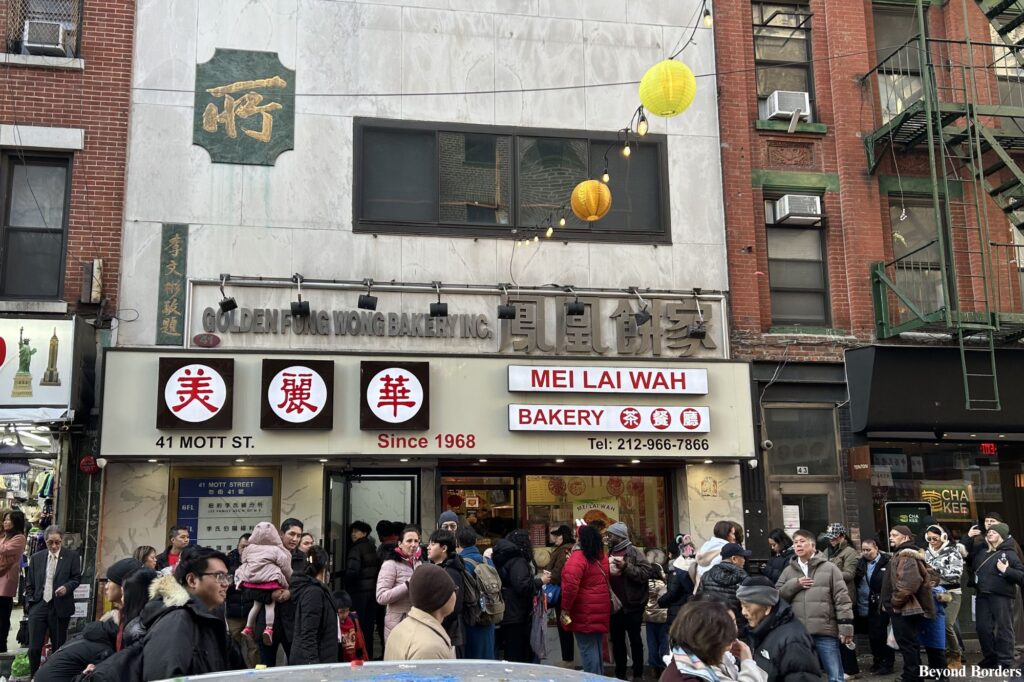
Walk down Bayard Street at any time of day, and you’ll see the same thing: a line of people holding phones and waiting for a legendary Pineapple Roast Pork Bun. Because of its massive TikTok and Instagram fame, some old-school locals will tell you it’s become a “tourist trap.” But here is the unfiltered truth: while the lines are real, the consistency is too.
Even with the viral hype, Mei Lai Wah remains an institution because they’ve perfected the balance of that sweet, crunchy “pineapple” crust and savory BBQ pork. Is it worth a 45-minute wait? Maybe not if you’re starving. But is it worth a visit to experience the gold standard of Chinatown bakeries? Absolutely. Use my procedure below to avoid waiting, and you’ll find that the “trap” is actually just a very well-deserved reputation. To see their full menu, visit their official website.
The Procedure: The “Kiosk vs. Cash” Strategy.
Step-by-Step:
- Do not automatically join the line snaking out the door. Walk inside and look to the far left for the self-service kiosks if you want to pay by card.
- This way, you will bypass the “cash only” line entirely if it’s too long.
- Pro-Tip: Their famous Baked Roast Pork Buns are often replenished every 15 minutes. If they look “sold out” on the screen, wait 5 minutes–a fresh tray is likely coming out.
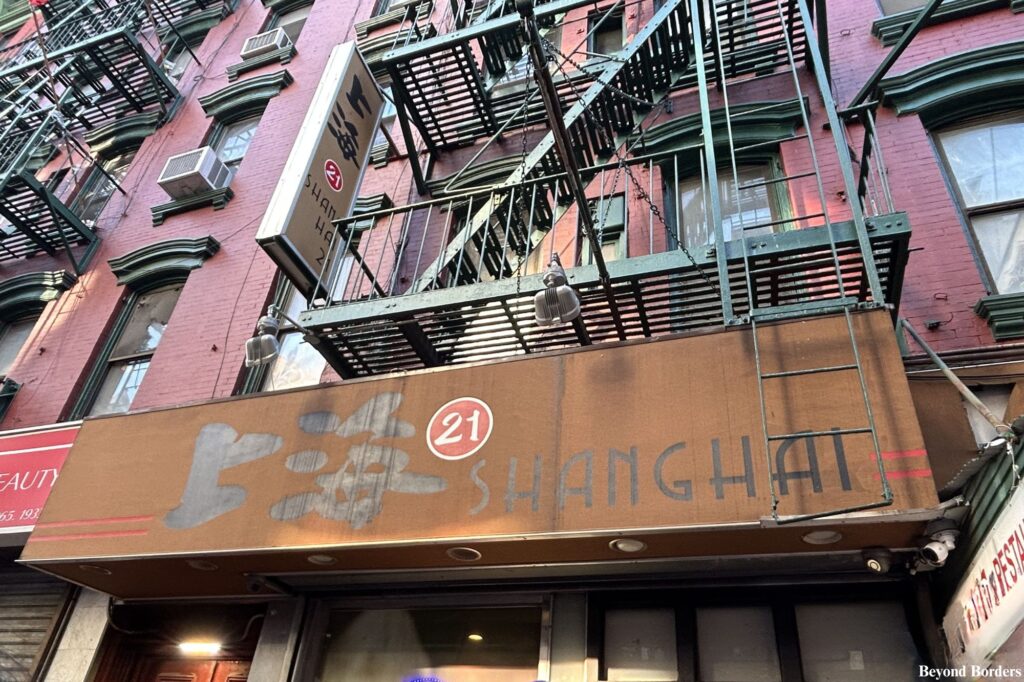
Shanghai 21
Located in the heart of Mott Street, Shanghai 21 is where you go when you want a “polished” version of the Chinatown experience without the white-tablecloth prices. Known for having some of the most delicate skins in the city, their Xiao Long Bao (soup dumplings) are consistently ranked among the best. It’s a bright, bustling space that feels a bit more modern than the basement joints nearby, making it the perfect middle ground for a sit-down lunch that still feels like an authentic “find.” To read their full menu, visit their official website.
The Procedure: The “Pivot” Move.
Step-by-Step:
- This spot is tiny. If the wait is over 30 minutes, put your name on the list and walk 1 minute to Aji Ichiban for snacks while you wait.
- They do not call your phone; you must stay within earshot of the door.
- Pro-Tip: Order the steamed vegetable soup dumplings. Most people only know the pork ones, but these are the “insider” favorites that rarely sell out.
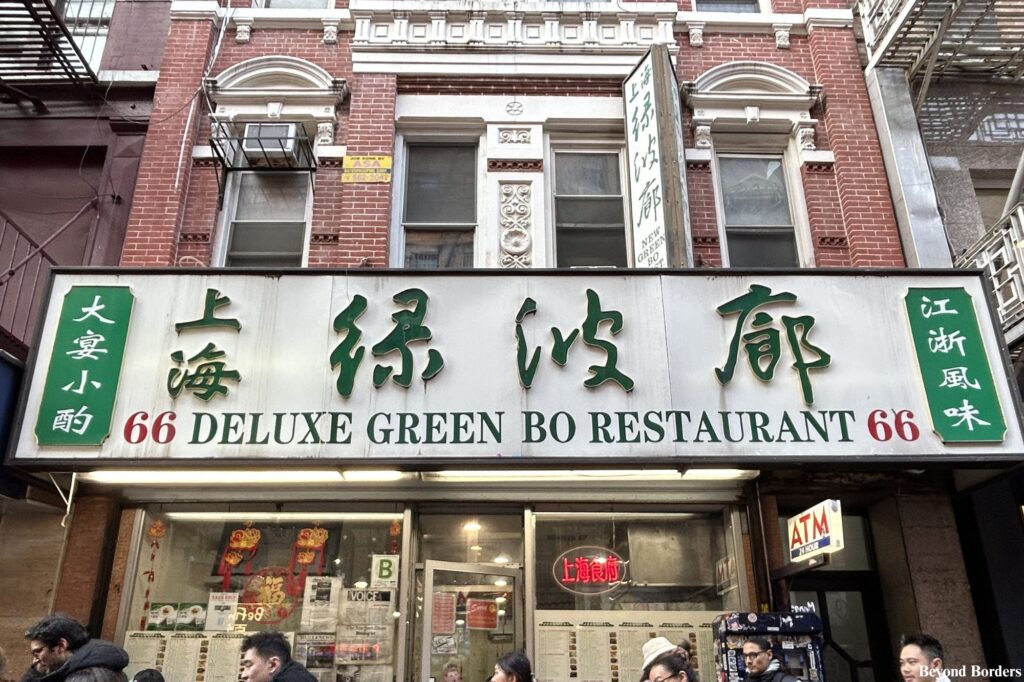
Deluxe Green Bo
Deluxe Green Bo is the definition of “don’t judge a book by its cover.” The exterior is modest, but inside you’ll find a high-energy Shanghainese powerhouse that moves at lightning speed. This is the spot for the “in-the-know” foodie who wants to skip the lines at Joe’s but still get elite-level Tiny Fried Buns (Sheng Jian Bao) and scallion pancakes. It’s a cash-only, no-frills environment where the tea is hot, the service is blunt, and the food comes out faster than you can check your phone. To read their full menu, visit their official website.
The Procedure: The “Cash-Ready” Entry.
Step-by-Step:
- This is a strict cash-only establishment! To skip the “ATM run” mid-meal, have your cash ready before you are seated.
- They practice “communal-style” seating for small parties. Be prepared to share a large round table to get seated faster.
- Pro-Tip: Their Scallion Pancakes are the fastest item on the menu. Order them the second you sit down to bridge the gap while your soup dumplings steam.
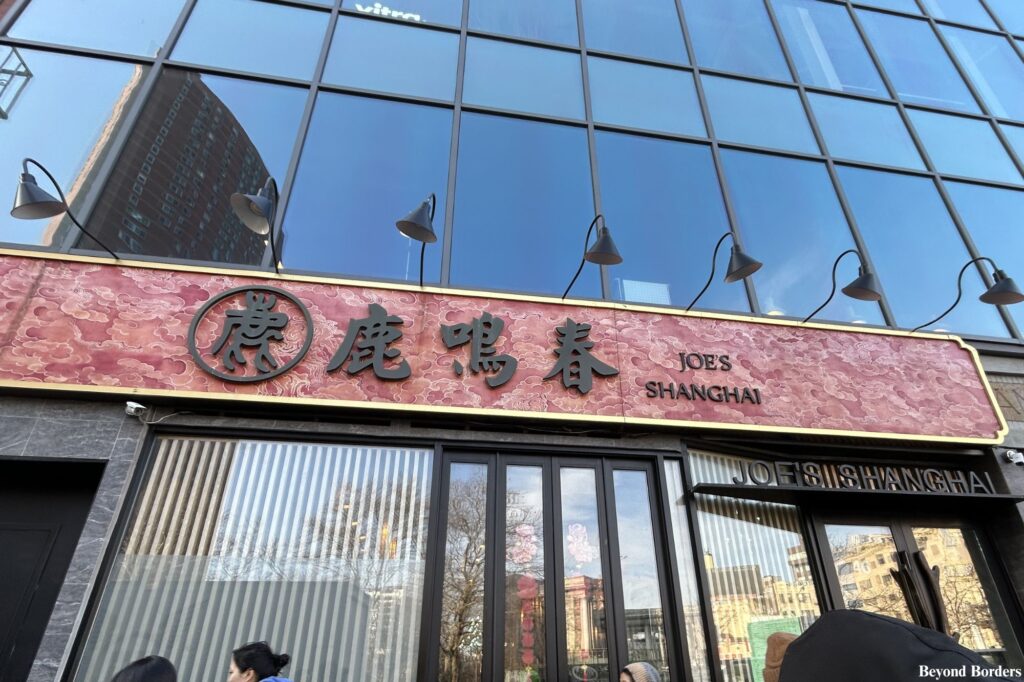
Joe’s Shanghai (46 Bowery)
If you spend any time on NYC forums (related to food or not), you’ll inevitably hear the claim that Joe’s Shanghai has become a “tourist trap.” And while it’s true that you’ll find more tourists here than at a tiny basement hole-in-the-wall establishment, there is a reason the crowds have never thinned out since they opened in 1994: their soup dumplings are undeniably elite (especially their pork and shrimp soup dumplings).
Joe’s is still a “must-visit-once” institution. Having moved from its original cramped quarters on Pell Street to a much larger, brighter space on Bowery, Joe’s has managed to scale its operation without losing the “magic” of its signature broth. It’s the heavyweight champion of the neighborhood–bustling, high-energy, and still the gold standard for that first, life-changing bite of a crab meat and pork soup dumpling. To see their full menu, visit their official website.
The Procedure: The “New Location” Advantage.
Step-by-Step:
- Since moving to the larger Bowery location, the “3-hour wait” is largely a thing of the past, but there are still wait times.
- Avoid 12:00pm and 7:00pm; arrive at 11:30am or 9:30pm for no wait.
- Pro-Tip: Unlike the old spot, this one is much more “influencer-heavy.” If you want a quieter meal, ask for a table in the back left corner–the acoustics are much better for conversation.
The Chinatown “Quick-Pick” Decision Matrix
| If you are… | Go To… | Because… |
| With a large, loud family | Wo Hop | The portions are huge, the vibe is indestructible, and the menu is crowd-pleasing. |
| In a massive rush (Grab & Go) | Mei Lai Wah | You can snag a $2–$3 pork bun and be back on the subway in under 10 minutes. |
| On a “First Date” lunch | Shanghai 21 | It’s the most “polished” and modern setting for a long, relaxed conversation over dumplings. |
| Solo and “In-The-Know” | Deluxe Green Bo | Fast service, high-velocity energy, and perfect for a solo diner looking for elite-level soup dumplings. |
| Hunting for a “Bucket List” classic | Joe’s Shanghai | It’s the world-famous staple for a reason. Go here if you want to say you’ve had the “original” soup dumpling. |
Know Before You Go: The Final Checklist
Before you head out, keep these three Chinatown “procedural” rules in mind for 2026:
- Bring Physical Cash: While spots like Joe’s Shanghai and Shanghai 21 take cards, the best “cheap eats” like Mei Lai Wah and Deluxe Green Bo are often cash only or have a $15–$20 minimum to pay with card.
- The “Magic Window”: To walk into any of these spots with zero wait, aim for 3:00pm – 4:30pm. This is the lull between the lunch rush and the early dinner crowd.
- Check the “Next Door” Option: If Wo Hop’s basement has a 40-minute wait, check the “Upstairs” location or the spot right next door. They often serve similar menus with half the wait.
How to Hit All 5 Spots in One Day
The “Perfect Chinatown Crawl” Budgeting Procedure
Because Chinatown is small, you can definitely try food from all 5 of these restaurants in one day! If you want to hit all 5 spots for a “sampling tour,” here is the exact breakdown you’d need:
| Restaurant | What to Order | Estimated Cost Per Order (2026) |
| Mei Lai Wah | 2 Roast Pork Buns + 1 Pineapple Bun (with roast pork) | $8 total (Cash only at counter–fastest line) |
| Joe’s Shanghai | Crab & Pork Soup Dumplings (8 pc) | $17.95 (Cash only, ATM has a surcharge) |
| Wo Hop (basement) | Roast Pork Egg Foo Young | $15.95 (Cash only) |
| Deluxe Green Bo | Tiny Fried Buns (with pork, 8 pc) | $9.95 (Cash only) |
| Shanghai 21 | Truffle Soup Dumplings (with pork, 6 pc) | $16.75 (Cash only) |
The “Cash & Carry” Rule for 2026
- The Total: For a full “sampling” day for two people, you need roughly $68.60 (excluding tip).
- The Procedure: Carry at least $45 in small bills ($1s, $5s, and $10s). Many of these spots are high-speed; waiting for change for a $50 bill at the Mei Lai Wah counter is the fastest way to feel a glare from locals in line behind you.
- The “Card Minimum” Hack: At the spots that do take cards, the minimum is often $20. If your dumplings only cost $12, have a backup “side dish” in mind (like scallion pancakes) to hit the minimum without scrambling.
The “Is It Worth It?” Cheat Sheet
| Restaurant | The Reputation | Is it actually worth it? |
| Joe’s Shanghai | “Tourist Trap” | Yes. The soup broth is still the most complex in the neighborhood. |
| Mei Lai Wah | “TikTok Viral” | Yes. But only if you use the cash shortcut if there is a long line. |
| Wo Hop | “Old News” | Yes. For the atmosphere alone; the basement is a time capsule. |
| Shanghai 21 | “Overpriced” | Yes. You’re paying for better ingredients and a cleaner, modern space. |
| Deluxe Green Bo | “Too No-Frills” | Yes. It’s the most authentic “no-nonsense” meal on the list. |
Even More Recommendations
- Shu Jiao Fu Zhou (Grand St): Cash only, wheat noodles with peanut sauce and pork and chive dumplings are worth trying.
- Jiang Nan (Bowery): Peking duck is worth trying; people say the suggested tip is calculated on the post-tax total.
- Kong Sihk Tong (Bayard St): Cash only, people say to order the golden lava French toast.
- Uncle Lou 快樂人 (Mulberry St): Patrons say to bring cash to get 9% off and to select dishes from the “Lo Wah Kiu favorites” section of the menu for more authentic food.
Conclusions
Navigating Manhattan’s Chinatown is more than just a meal; it’s a masterclass in New York efficiency. By following this budget-friendly procedure, you’ve not only saved money but also experienced the authentic, fast-paced heart of the neighborhood that most tourists miss. Whether you’re standing on a street corner with a $3 scallion pancake or finding a quiet moment in Columbus Park with a pork bun, you’re now eating like a true New Yorker.
If you’re ready to continue your culinary tour of NYC, here is where to head next:
- Heading North? Check out my guide to the 5 Best Cheap Eats in Times Square for “dash-and-dine” strategies perfect before a Broadway show.
- Exploring Deeper Downtown? Don’t miss my Downtown NYC Itinerary. I dive into the legendary Nom Wah Tea Parlor (the oldest dim sum spot in NYC!) and guide you through the best specialty shops for Chinese herbs, tea, and ceramics.
- Craving More Heat? If this Chinatown crawl sparked a love for bold flavors, head over to my West & East Village Itinerary. I feature the East Village location of Mountain House, where you can enjoy world-class Szechuan in a more relaxed, “village-vibe” setting compared to its busy Midtown location near Times Square.
No matter where the subway takes you, remember: the best flavor is usually found just one block away from the crowds!