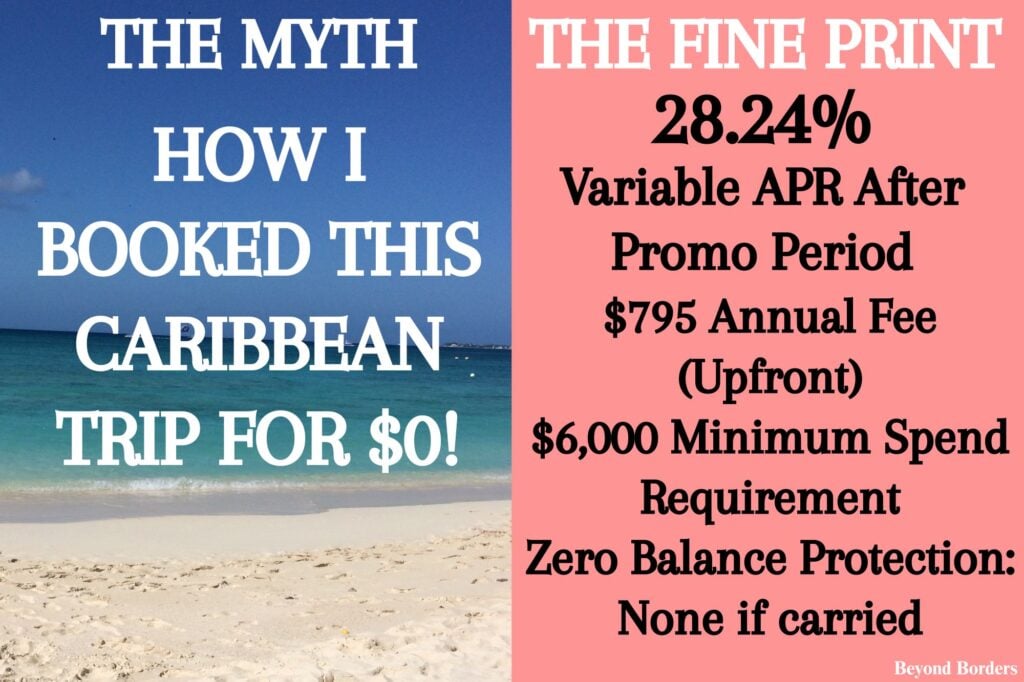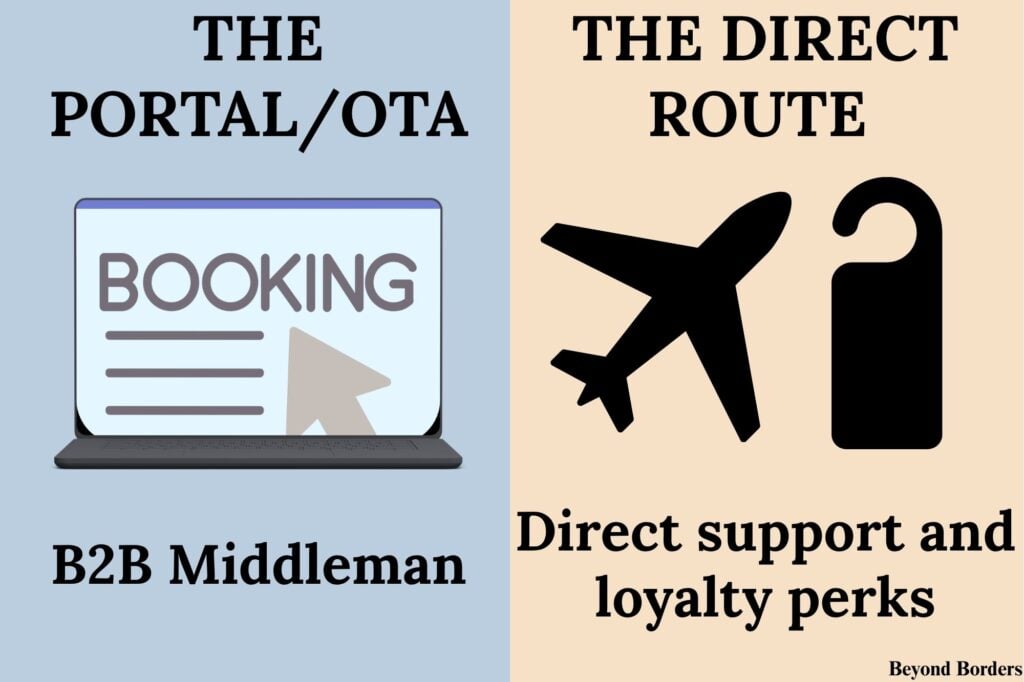
When planning a trip, the debate over booking direct vs third party sites usually comes down to price. But while online travel agencies (OTAs) and credit card bank portals promise lower rates or bonus points, what happens behind the scenes when a flight is delayed, a reservation is lost, or plans change?
Booking Direct vs. Third Party OTA Sites:
While credit card portals and online travel agencies (OTAs) market convenience and point multipliers, they operate as commercial middlemen built on wholesale B2B commission markups, static inventory, and ticket ownership locks for flights. This guide breaks down the hidden risks of third-party bookings, the truth about “Agent of Record” restrictions, and when booking direct is non-negotiable.
Disclaimer: You’ll see affiliate links for booking platforms like Booking.com or Expedia across this site, including on our general destination guides/itineraries. When you book through those links, we may earn a small commission at no extra cost to you–which funds our independent, field-tested travel guides. However, our editorial integrity comes first. We will never tell you an OTA is the right choice when booking directly with the accommodation offers you better protection, loyalty perks, or customer support. We use these links pragmatically, and we want you to use these tools knowledgeably.
Editorial and Trademark Disclosure: Beyond Borders is an independent digital publication providing educational analysis and consumer commentary on travel logistics and travel rewards, along with our independent, field-tested travel guides. All product names, trademarks, and registered trademarks mentioned on this website (including bank portals, hotel chains, and airlines) are the property of their respective owners and are used strictly for identification, educational, and comparative purposes. Reference to these brands does not imply endorsement or affiliation.
Introduction
If you’ve spent any time on travel social media recently, you’ve likely seen creators highlighting “secret” flight portals, credit card points multipliers, or aggregator search engines that claim to unlock unbeatable hotel rates. In an era where travel costs feel higher than ever, saving $50 or earning 5x points on a booking sounds like an obvious win. What those short-form videos rarely explain, however, is the structural reality of how these bookings actually function behind the scenes.
When you book through a third party—whether it’s a giant online travel agency (OTA) like Expedia or Booking.com, or a sleek credit card travel portal—you are not simply purchasing a hotel room or an airline ticket. You are entering a three-party contract where an intermediary sits firmly between you and the company actually providing your accommodation or transit.
When a trip goes perfectly, the middleman architecture remains invisible. But the moment something breaks—cancellation due to poor weather, an overbooked hotel, a schedule change, or a missing confirmation—the friction points of third-party bookings quickly surface.
Third-party sites (OTAs) and bank travel portals are not neutral booking engines; they are commercial intermediaries built around wholesale commission margins, static distribution feeds, and ticket ownership transfers.
In this deep dive, I am unpacking what OTAs and credit card portals don’t tell you: how inventory management works, who actually controls your ticket when disaster strikes, the fine print on elite status, and how to decide when booking direct is non-negotiable versus when leveraging a third party actually makes financial sense.
Jump to my Quick-Reference FAQs ↓ at the bottom of this guide if you have a specific question!
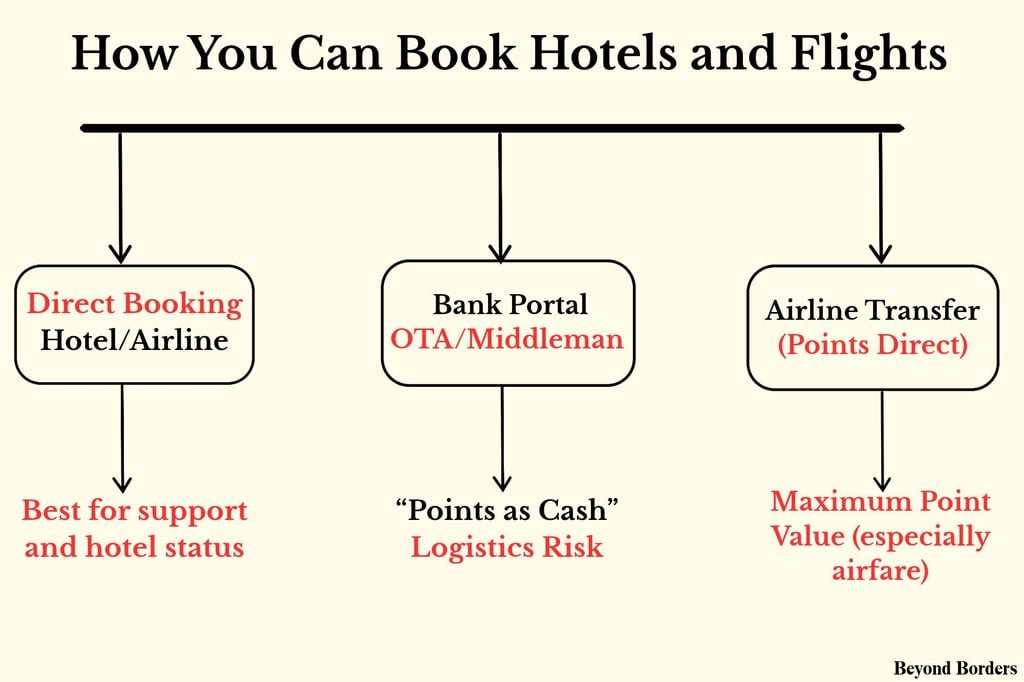
Booking Hotels vs. Flights Across Three Main Methods
Is It Better to Book Directly With a Hotel? The Four Core Hotel OTA Traps
When you book a room directly on a hotel’s website, you enter a simple, two-party transaction: you pay the hotel, and the hotel provides your room.
When you book through a third-party Online Travel Agency (OTA) like Expedia or Booking.com or through a credit card travel portal, that transaction transforms into a complex, multi-party contract. A tech middleman sits between you and the front desk, operating on its own commission margins, software feeds, and profit logic.
While these portals promote ease and point rewards, booking through an intermediary frequently results in higher prices and stripped-down perks. The price gap comes down to four core mechanics of online travel distribution:
1. Wholesaler Middlemen Take a Cut: A B2B Wholesale Model
Credit card companies like Chase, Capital One, or American Express do not build or run their own travel booking systems. Instead, they white-label their portals. Behind the bank’s sleek logo sits a third-party booking engine, such as Expedia Group, cxLoyalty, or Sabre, who handles the underlying travel infrastructure.
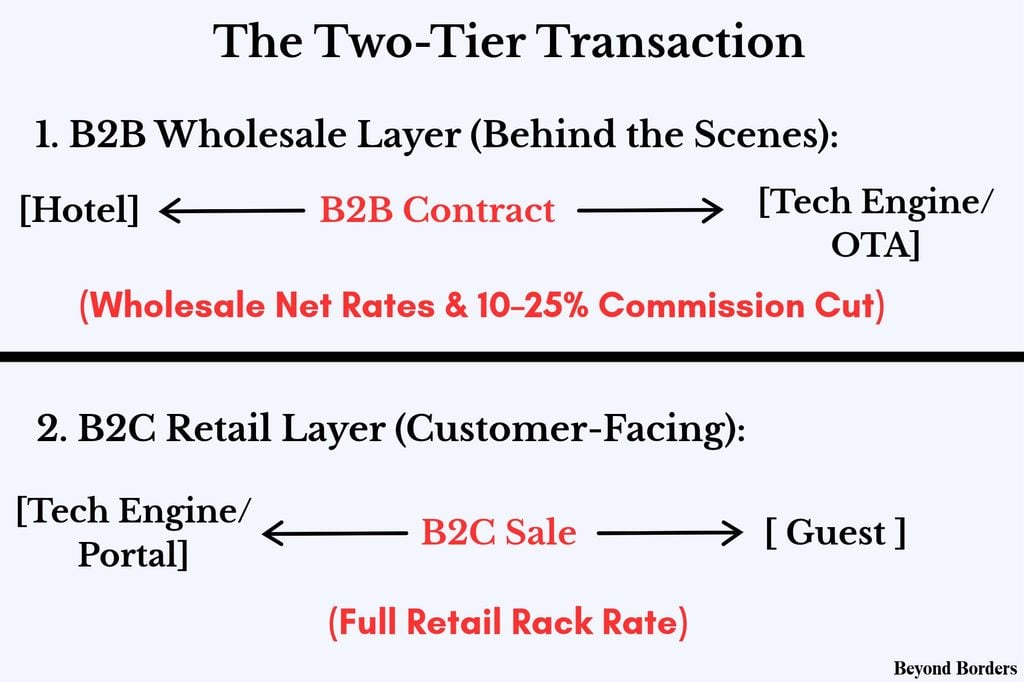
What most travelers miss is that using a third-party portal transforms a direct booking into a classic Business-to-Business (B2B) wholesale transaction rather than a simple Business-to-Consumer (B2C) relationship:
- The B2B Backend: The tech provider negotiates commercial rate inventory directly with hotel chains on a wholesale, B2B level. Every step in this middleman chain requires a cut, covering software infrastructure, customer service routing, and profit splits between the booking engine and the bank. To account for these 10% to 25% commission fees, hotels push their highest baseline rates (known as the “rack rate”) to portal feeds.
- The B2C Frontend: The bank’s portal then turns around and sells that middleman inventory to you at retail.
Because the underlying transaction is B2B, the hotel treats the tech agency—not you—as the primary customer on record.
You can read more about the economics of white-label travel portals here and commissions here.
2. Member Loyalty Discounts Are Blocked
Hotels prefer direct bookings to avoid paying third-party commissions. To encourage guests to book directly, major chains (e.g., Marriott, Hyatt, Hilton, and IHG) keep their best prices behind a loyalty firewall. Examples of hotel loyalty programs include Hilton Honors, Marriott Bonvoy, and World of Hyatt.
- Direct Web Rate: Logging into a free hotel loyalty account unlocks a “Member Rate” (typically 5% to 15% off) plus perks like complimentary Wi-Fi, room selection, and digital key access.
- Portal Rate: OTAs and bank portals only get access to standard, public non-member rates.
Even if a portal claims it isn’t marking up a room, the price can easily appear 10% to 15% higher than what you see on the hotel’s site simply because member discounts are blocked on third-party channels.
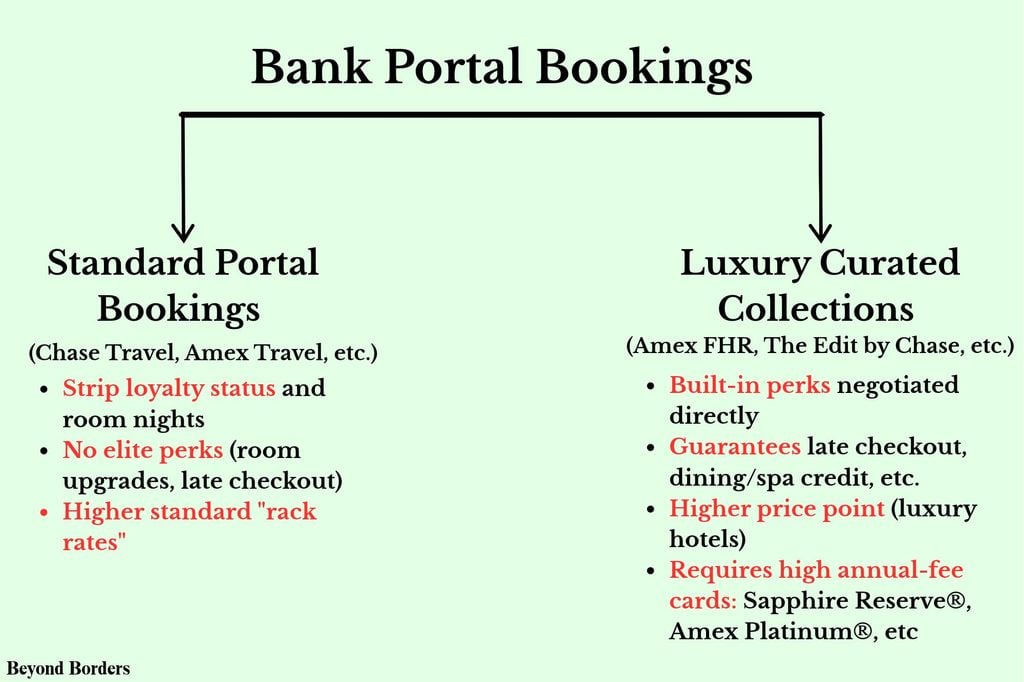
Furthermore, most hotel chains enforce a strict policy: if you don’t book direct, you don’t earn loyalty credits. Booking a hotel through an OTA or a bank portal like Chase or Amex, for example, means:
- You earn zero elite status qualifying nights.
- You earn zero hotel loyalty points on the room rate.
- The front desk is not required to honor existing elite perks (like free breakfast, room upgrades, or late checkout).
Why This Matters
Staying in prime commercial and tourist hubs like Midtown Downtown Manhattan commands some of the highest nightly lodging rates in the USA. While OTAs might occasionally show a near-identical baseline rate, booking those properties through a third-party portal can backfire: stripping away the guaranteed 2% to 5% member rate, free Wi-Fi, and even free daily breakfast that you can only secure by booking direct through the hotel’s app or website. When navigating these high-cost areas, it is essential to look to major flag hotel chains to offset expenses through points or member discounts. I recommend several highly-rated hotel chain properties in my post on the best hotels in Midtown NYC and my post on the best hotels in Downtown NYC.
The Exception (Premium Luxury Collections)
Premium credit card programs—such as The Edit by Chase Travel (for Chase Sapphire Reserve® cardholders) or Amex Fine Hotels + Resorts (for American Express Platinum® or Centurion® cardholders)—are the main exception. Because these specific programs negotiate rates directly with participating luxury properties, they bundle cardholder perks directly into the booking, including guaranteed late checkout, breakfast credits, and room upgrades.
However, for standard everyday hotel bookings across standard portal tiers, third-party bookings almost always strip your loyalty benefits. Additionally, the Chase Sapphire Reserve® and Amex Platinum® credit cards have annual fees of $795 and $895 respectively, which is not in the average traveler’s budget! Read more about these cards and additional travel rewards credit cards in Part 1 of this series, The Truth About Credit Card Rewards and Travel Influencers.
3. “Dumb Pricing” Algorithms and Static Inventory
Hotels adjust room rates continuously using dynamic revenue-management algorithms that respond in real time to local demand, room cancellations, and weather conditions. Hotel websites update frequently to reflect these sudden price drops or flash sales.
Third-party travel portals pull room availability through legacy distribution networks called Global Distribution Systems (GDS) (of which Sabre is one) or third-party API caches. These external feeds refresh far less frequently than a hotel’s internal reservation system:
The Static Inventory Lag: If a hotel drops its rate from $300 to $220 at 4:00pm to fill unsold rooms for the weekend, its main website reflects that $220 deal immediately. A bank portal, however, may continue displaying the old $300 static rate for hours—or show a room as “Sold Out” even when the hotel has available inventory.
What About Credit Card Price Match Guarantees?
To combat the perception that portals charge higher rates, major banks have introduced price matching features (such as Chase Travel’s Price Match Guarantee for hotels under The Edit for Sapphire Reserve® cardholders or Capital One® Travel’s rate match). While this sounds like a great safety net, the burden of proof rests entirely on the consumer:
- Prepaid Hotels Only: It only applies to prepaid hotel bookings; it does not cover flights, rental cars, or pay-at-property stays.
- The 24-Hour Clock: You must manually cross-check rates across other booking platforms and file a claim within 24 hours of your portal booking.
- Member Rate Exclusions: Portals generally refuse to match the discounted “Member Rates” offered directly on hotel websites. If Hyatt lists a room at $220 for logged-in members while Chase shows $250, Chase will often reject the match because the $220 rate requires a free loyalty login.
- Strict Matching Rules: The lower rate must match everything identically: exact same room type, bed configuration, cancellation/refund policy, number of guests, and travel dates.
The Real Takeaway: Price matching guarantees exist because portal algorithms lag behind live hotel pricing. Instead of getting the lowest rate automatically at checkout, you are forced to act as an unpaid auditor to claim a refund for a middleman’s pricing delay.
4. Recapturing the “Points Boost”
Banks frequently promote high point multipliers to encourage portal usage, offering 10x points on hotels booked through Chase Travel or 5x points through Amex Travel. However, offering high multipliers costs banks money. To offset those costs and fund statement credits (like a $50 annual hotel credit), portals structure their pricing logic to recapture that lost revenue on the base rate.
When a room costs $250 directly from the hotel but $290 on a bank travel portal, the $40 markup directly funds your “bonus” points. You are not receiving a true discount; you are paying a cash premium to buy back your own credit card rewards.
Key Takeaway: The Portal Markup Trap
Credit card travel portals are white-labeled online travel agencies (OTAs) operating on multi-layered commission structures. Between un-discounted rack rates, blocked loyalty discounts, and portal commission margins, a hotel room listed on a bank portal can easily cost 10% to 30% more than booking directly. When consumers apply a statement credit or chase a 10x point multiplier on an inflated portal rate, they are often using their benefits to subsidize a middleman’s markup.
Are Credit Card Travel Portals Really Direct Bookings?
The Airfare and Points Twist
After looking at hotel commission cuts and blocked loyalty rates, a natural question arises: Are credit card travel portals really direct bookings when it comes to flights? The short answer is no. Just like hotel portals, bank flight portals (such as Chase Travel, Amex Travel, and Capital One Travel) are white-labeled online travel agencies powered by global distribution systems (GDS) like Sabre or Travel Management Companies (TMC) and B2B travel platforms that use GDS platforms, such American Express Global Business Travel, known as GBT.
However, booking flights through a portal introduces a completely different set of rules than hotels, with distinct advantages and hidden operational risks.
1. The “Agent of Record” Problem During Flight Issues
When you buy a ticket directly on an airline’s website (e.g., Delta.com or United.com), the airline acts as the issuing carrier. If a storm hits, a connection is missed, or a flight is canceled, airport gate agents and phone reps can rebook you directly onto the next available departure.
However, when you book a flight through a credit card portal, the portal becomes the “Agent of Record” for your ticket.
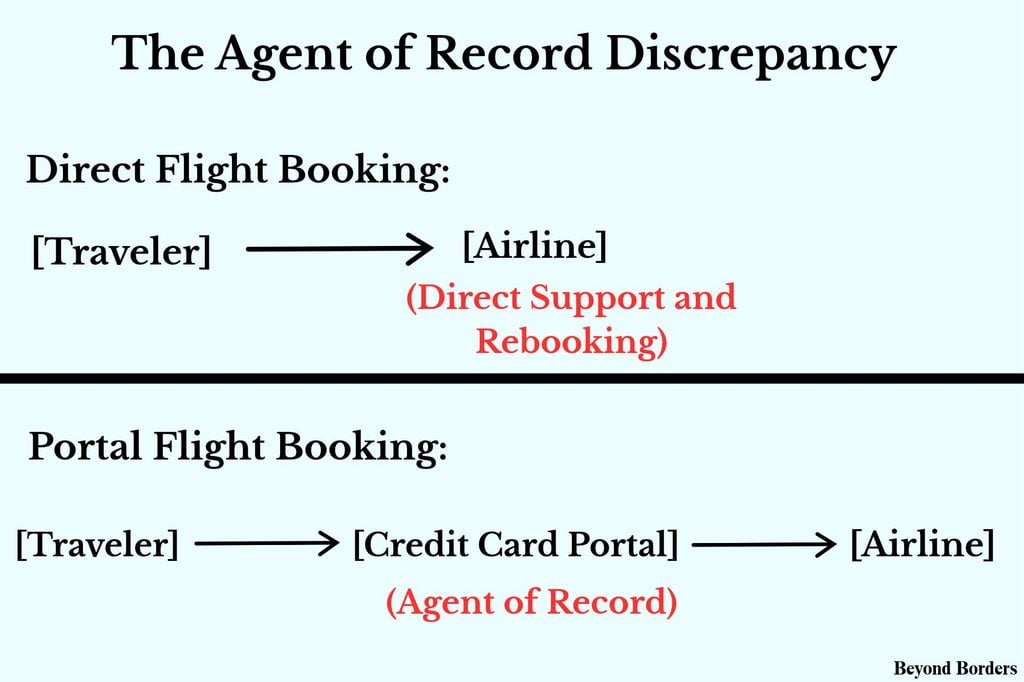
Because an intermediary holds the ticketing authority, severe delays or cancellations often trigger a customer service hand-off:
- The Airline’s Stance: “Because this ticket was issued by a travel agency, your agent has to process the change or issue the refund.”
- The Portal’s Stance: “We have to wait for the airline to clear the waiver before we can alter your itinerary.”
During major travel disruptions, this middleman hand-off forces travelers onto long hold lines with portal customer service while direct-booking passengers get rebooked on the spot at the gate.
2. What is an “Agent of Record”? Industry Jargon Explained
In airline distribution, and Agent of Record (AOR) refers to the travel/ticketing agency, management company, or booking platform that holds the administrative and ticketing rights to a passenger’s airline reservation.
When you purchase a flight through a third party, the booking engine processes the reservation through an industry clearinghouse—such as the Airlines Reporting Corporation (ARC) in the USA or IATA internationally—to generate an official 13-digit e-ticket. That ticket is tied directly to the agency’s credentials, designating them as the Agent of Record:
- Direct Booking: You buy on United.com
→United is the issuing carrier and owner of the ticket. United phone representatives and gate agents have full authority to modify, exchange, or refund your seat at any time. - Portal Booking: You buy on Chase Travel or Amex Travel
→The underlying booking engine (like cxLoyalty, Expedia, or Sabre) is designated as the Agent of Record.
Until control of the ticket is officially transferred to the airline’s airport gate system (which typically occurs during the 24 to 48-hour check-in window before departure) the airline’s system literally locks airline customer service agents out from editing or refunding the reservation.
Unless you hit that tight check-in window, front-desk airline agents cannot touch your ticket because they don’t hold the Agent of Record status—the third-party agency does. You can read more about the ARC here.
3. The Airfare Twist: Earning Miles vs. Losing Hotel Status
This is where flights diverge significantly from hotel bookings:
| Feature | Hotel Portal Bookings | Flight Portal Bookings |
| Loyalty Status Recognition | ❌ Blocked/Stripped | ✅ Honored on board |
| Earning Frequent Flyer Miles | ❌ No room night or point accrual | ✅ Earns airline elite miles and cash fare points |
| Ticket Ownership | Portal owns the B2B reservation | Portal owns the “Agent of Record” ticket |
When you book a flight through a bank portal, the airline views the transaction as a standard cash revenue ticket. This means:
- You do earn airline frequent flyer miles on the flight.
- You do earn elite qualifying credit toward airline status.
- Your existing airline elite status perks (like free checked bags, seat upgrades, and priority boarding) still attach to your reservation.
While flight portals preserve your in-flight status perks, the trade-off remains structural: you trade direct ticket ownership for portal point multipliers.
4. Fixed Portal Point Values vs. 1:1 Airline Transfer Partners and Alliances
Most travel reward credit cards market portal flight redemptions around fixed cash conversions, offering 1¢ per point, or a boosted 1.25¢ to 1.5¢ per point on select premium cards.
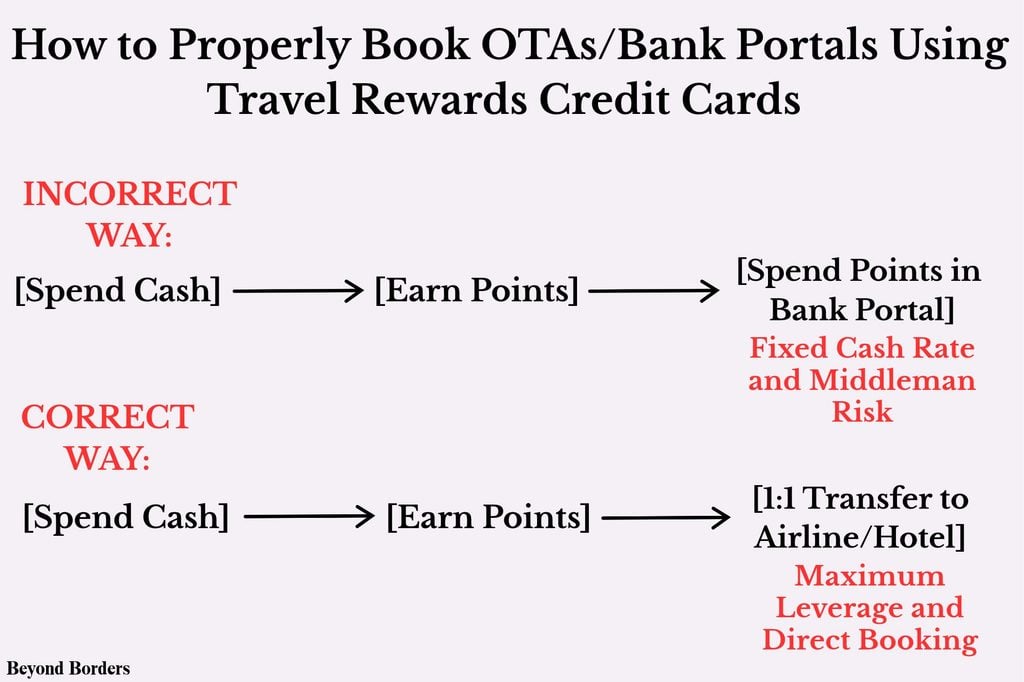
While redeeming points in a portal feels straightforward, it ties the cost of your award ticket directly to the cash price of the airfare:
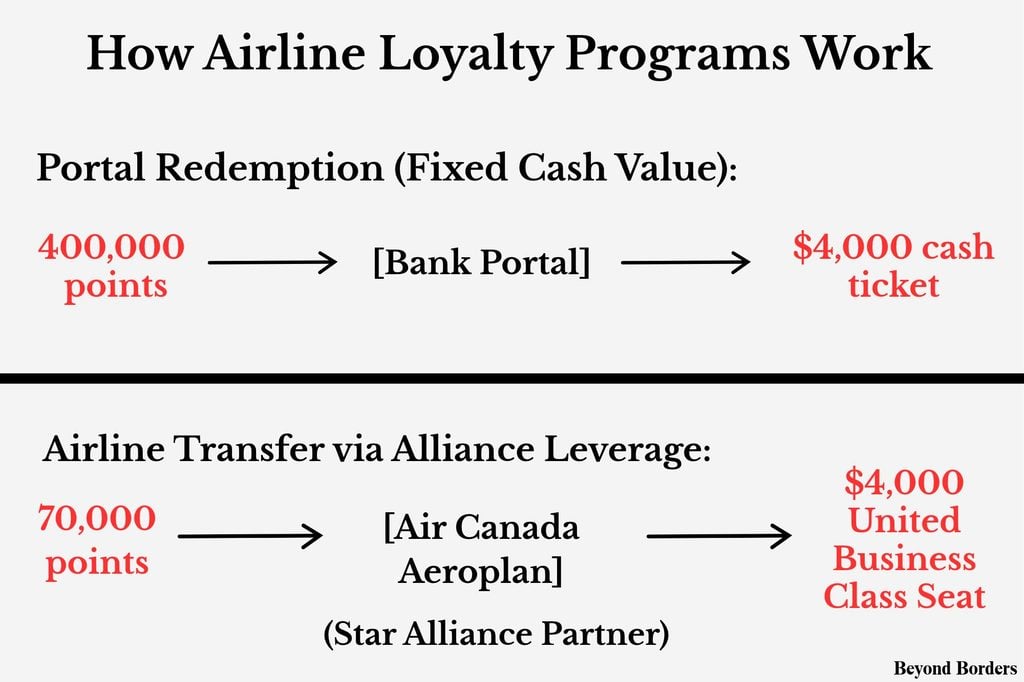
The Fixed Value Trap: If an international Business Class ticket costs $4,000 cash, booking it through a credit card portal at 1.25¢ per point requires a staggering 320,000 points!
Step 1: The Direct 1:1 Point Transfer
Instead of spending points like cash inside a middleman portal, flexible reward programs (like Chase Ultimate Rewards, Amex Membership Rewards, and Capital One Miles) allow cardholders to transfer points 1:1 directly to partner airline loyalty programs (e.g., Air France/KLM Flying Blue, Air Canada Aeroplan, or Virgin Atlantic).
Transferring points directly to an airline unlocks two major advantages:
- Unlinked Point Values: That same $4,000 Business Class seat booked via an airline award chart might only cost 70,000 to 80,000 transferred points plus modest taxes.
- Direct Relationship: Once points are transferred to an airline, you book directly on the airline’s site. If plans change, you deal directly with the airline’s customer service desk, completely bypassing the portal middleman!
Step 2: Unlocking Global Airline Alliances
Once you understand 1:1 transfers, the real secret weapon comes into play: Global Airline Alliances. Airline Alliances are closely related to airline loyalty programs, but are not the same thing:
- An Airline Loyalty Program (Frequent Flyer Program) is an individual airline’s specific rewards program (e.g., Air Canada Aeroplan, British Airways Executive Club, United MileagePlus, or Delta SkyMiles). You transfer credit card points into these loyalty accounts.
- An Airline Alliance is an international partnership made up of multiple airlines (the “Big Three” global alliances are Star Alliance, Oneworld, and SkyTeam).
Because member airlines within an alliance share award booking space, understanding alliances unlocks the true power of 1:1 point transfers. It means you don’t need to hold points in every airline’s program, you just transfer points to one alliance partner, and use that partner’s miles to book flights on any airline in that alliance. You can read more about airline alliances here.
Nearly every major international airline belongs to one of three global airline alliances:
- Star Alliance (United, Air Canada, Lufthansa, Singapore Airlines, ANA, etc)
- Oneworld (American Airlines, British Airways, Qatar Airways, Alaska Airlines, Cathay Pacific, etc)
- SkyTeam (Delta, Air France, KLM, Virgin Atlantic, Korean Air, etc)
Because alliance members share award inventory, transferring your bank points to one airline’s loyalty program lets you book award seats across any member airline in that alliance.
The Alliance Hack: Want to fly United Business Class to Europe? If United wants 150,000 miles for the seat on its own site, you can transfer 70,000 Chase, Amex (or other rewards program) points to Air Canada Aeroplan (a Star Alliance partner) and book that exact same United seat for half the points!
Just like booking through an airline loyalty program, transferring points directly to an airline alliance unlocks two massive advantages over bank portals:
- Award Chart Leverage: You detach your points from the cash price of the ticket, unlocking $4,000+ business class seats for a fraction of the portal point cost.
- Direct Ticket Ownership: Once points are transferred and booked, you hold a direct reservation with the operating airline. You completely bypass the “Agent of Record” middleman, meaning the airline’s customer service handles your seat, changes, and delays directly!
The Real Risks of Booking Through Third Party Sites
When a trip goes smoothly, a third-party booking feels no different from a direct one. The middleman architecture remains invisible, until a storm grounds flights, a schedule changes, or a hotel oversells its rooms.
When travel breaks down, the structural differences between direct bookings and OTAs become painfully apparent.
1. Customer Support Ping-Pong
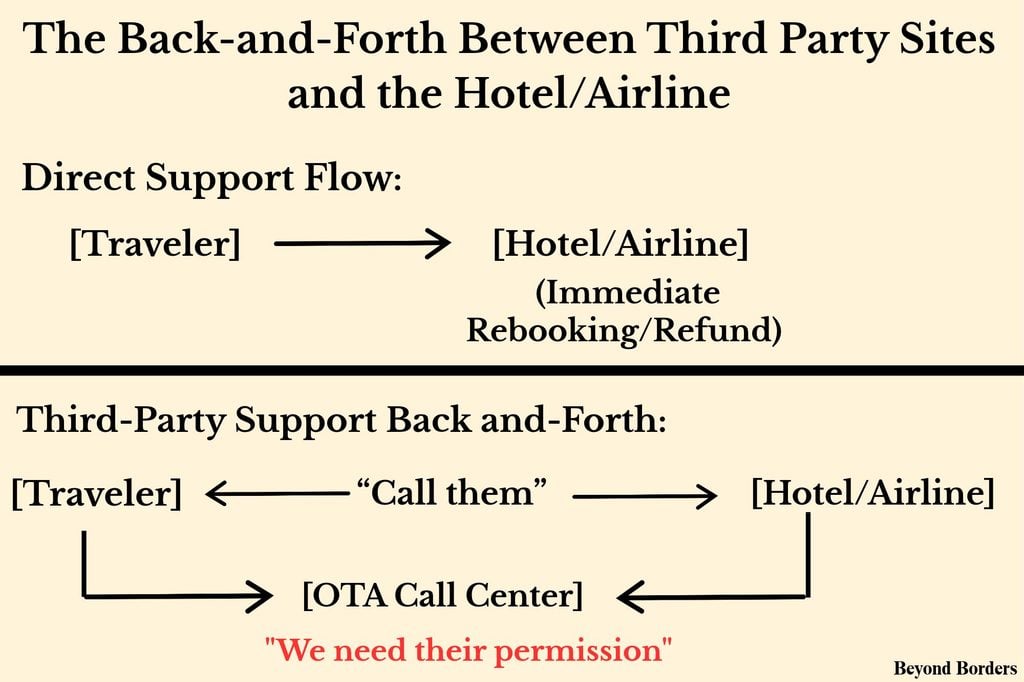
The most common risk of third-party bookings is the endless customer service hand-off. Because an intermediary sits between you and the travel provider, neither side takes immediate responsibility during a disruption.
While this is similar to the Agent of Record problem during flight issues I talked about above, the software lock that occurs is only half the problem; the real nightmare is the human service loop. When a storm hits, for example, the airline agent at the airport gate tells you to call your OTA. When you call the OTA, a third-party call center rep puts you on hold to “request permission” from the airline. You are trapped in an operational loop where neither side takes ownership of your trip:
- The Provider’s View: “You booked through an agency, so our system locks us out from editing your reservation. You have to process changes through your booking agent.”
- The OTA’s View: “We are just the booking portal. We have to contact the airline or hotel directly to request a waiver before we can issue a refund or rebook you.”
This setup forces travelers onto hours-long hold lines with third-party call centers while passengers who booked direct get rebooked right at the airport desk or inside the airline’s mobile app.
2. The “Walked” Guest Hazard: Overbooked Hotels
Hotels routinely overbook rooms to account for last-minute cancellations and no-shows. When every confirmed guest actually shows up, the hotel front desk has to “walk” the remaining guests to a neighboring property.
When a hotel is forced to walk guests, third-party reservations are almost always the first to be reassigned:
- Loyalty Protection: Hotel chains prioritize their direct bookers and elite loyalty members to protect direct customer relationships and avoid paying compensation penalties.
- Voided Reservation Guarantees: Major hotel brand guarantees (like Marriott’s Ultimate Reservation Guarantee or Hyatt’s Reservation Guarantee)—which pay cash compensation or cover your room at a nearby property if you are walked—explicitly exclude third-party OTA bookings in their fine print.
If a hotel runs out of rooms at 11:00pm, a guest who booked direct receives an apology, a comped room at a nearby hotel, and loyalty compensation. A guest who booked through a third party is often told to contact their OTA for a refund and left to find a new room on their own.
Read more about what it means to be “walked” by a hotel here and reservation guarantees by hotel chains for “walked” reservations here.
3. Fine-Print Traps and Refund Delays
Canceling or modifying a direct booking usually follows straightforward rules: cancel on the hotel website before the 24-hour deadline, and your credit card is refunded or your deposit is released.
Third-party bookings introduce additional layers of friction:
- Double Cancellation Windows: An OTA may impose an earlier cancellation deadline than the hotel itself, or charge a non-refundable service fee even if the hotel policy allows free cancellation.
- The “Floating Money” Problem: When an OTA grants a refund, the money doesn’t move directly from the hotel to your bank account. The hotel must first refund the wholesaler, the wholesaler refunds the OTA, and the OTA eventually credits your account—a process that can take weeks or months during major disruption events.
- Use-It-or-Lose-It Airline Credits: If you cancel a flight booked through a credit card portal, the resulting airline credit often remains tied to the portal’s “Agent of Record” ticketholding system. You can rarely apply that credit directly on the airline’s website for future travel; you are forced to rebook through the bank’s portal.
How to Decide: When to Book Direct vs. When to Use an OTA
Understanding the underlying economics of OTAs and bank portals isn’t about throwing them out entirely, it’s about knowing when the trade-offs work in your favor and when they expose you to unnecessary risk.
To streamline your booking decisions, use this practical matrix to determine when to hit “Book Direct” and when leveraging an OTA or travel portal actually makes sense.
Choosing Between Booking Direct vs Third Party/OTA
| Booking Scenario | Recommended Strategy | Primary Reason |
| Hotels (Major Chains) Marriott, Hyatt, Hilton, IHG | Book Direct | Hotel owns record, protects member rates (5–15% off), guarantees room night accrual, and ensures elite status perks are honored. |
| Hotels (Independent/Boutique) | Compare Both | OTA owns record; independent hotels often lack robust loyalty programs; check if an OTA rate or card portal credit beats the direct rate. |
| Cash Flights (Connecting/International) | Book Direct | Keeps ticket ownership with the airline, bypassing “Agent of Record” locks during delays, schedule changes, or cancelations. |
| Cash Flights (Straightforward/Domestic) | Use Portal (With Caution) | OTA/bank portal owns e-Ticket; acceptable if using an annual card credit, but ensure you check in 24 hours early to pass control to the airline. |
| Award Redemptions (High-Value Flights/Hotels) | Direct 1:1 Transfer | Direct loyalty account; detaches points from cash prices, unlocking maximum point leverage and direct reservation control. |
Your Pre-Booking Checklist
Before hitting “Confirm” on any third-party/OTA or portal travel booking, run through this 4-step sanity check:
- [ ] The True Rate Check: Did you log into the hotel or airline’s free loyalty account to see their direct “Member Rate”?
- [ ] The Math Check: Is the portal point multiplier (e.g., 5x/10x) offsetting a base rate that is marked up by 10% to 30%?
- [ ] The Risk Check: If this flight is canceled or delayed, am I comfortable calling the portal’s phone support instead of the airline gate agent?
- [ ] The Transfer Check: Can I transfer these bank points 1:1 to an airline alliance partner or hotel program and book directly for fewer total points?
The Other Side of the Coin: When Using an OTA or Bank Portal Is Actually Worth It
After examining commission markups, static inventory lags, and “Agent of Record” customer support ping-pong, it is easy to assume that third-party booking sites and bank travel portals should be avoided entirely.
That is not the takeaway. Third-party travel agencies exist because they solve real distribution problems, and in specific scenarios, the benefits of using an OTA or portal outweigh the structural trade-offs.
The key is knowing precisely when the middleman model works in your favor.
1. Where OTAs and Portals Deliver Real Value
- Boutique and Independent Hotels: Independent properties and small boutique inns rarely offer robust loyalty programs or member discounts. When there is no loyalty status to lose or stay credits to earn, comparing an OTA rate (or using a bank portal statement credit) against the hotel’s direct rate is a fair fight.
- I recommend several independently owned and operated hotels across my NYC accommodations posts throughout Manhattan and in Brooklyn and Queens.
- Flight and Hotel Vacation Packages: OTAs excel at opaque package rates. Hotel chains and airlines often allow OTAs to deeply discount bundled inventory (flight and hotel) because the individual wholesale price of the room or seat is hidden inside the total package price.
- Fixed-Value Credit Card Credits: If your credit card offers an annual portal credit (such as the $100 annual Chase Travel credit on the Sapphire Preferred® or the the $300 annual Capital One Venture X® travel credit), using it on a simple, low-risk domestic flight or boutique hotel booking effectively offsets your card’s annual fee.
- Consolidated Travel Management: For casual travelers who take one or two trips a year across different airline and hotel brands, having a single dashboard to track reservations can outweigh the hassle of managing several separate travel accounts.
2. Connecting the Dots: Bank Portals ARE OTAs (“The Points Wrapper”)
This brings us to the core bridge between travel booking platforms and travel rewards credit cards: when you book through Chase Travel, Amex Travel, or Capital One Travel, you are using an Online Travel Agency.
Behind the polished bank interface sits a white-labeled booking engine (e.g., Expedia, Sabre, or cxLoyalty). Behind sleek bank interfaces sit white-labeled engines or in-house agency acquisitions (such as Chase acquiring cxLoyalty in 2020 or Capital One acquiring Hopper’s travel technology and core staff in 2026). Whether a bank partners with a third party or buys the agency outright, the underlying architecture remains an Online Travel Agency, operating under standard B2B commission rules, GDS inventory feeds, and agency ticketing locks. The bank is simply acting as a retail storefront for an existing OTA infrastructure. Think of it like buying a gift box:
- Inside the Box (The Mechanics): The actual item inside is a standard Expedia reservation with third-party rules, “Agent of Record” locks, and no hotel loyalty night credits.
- The Wrapping Paper (The Wrapper): The bank puts a sleek logo, a “$300 annual credit,” and “10x Points” packaging around the box to make it feel like a exclusive bank perk rather than an OTA middleman.
The bank isn’t running a separate travel company, it is simply placing a “Points Wrapper” (high multipliers, statement credits, and “pay with points” buttons) over a standard third-party agency.
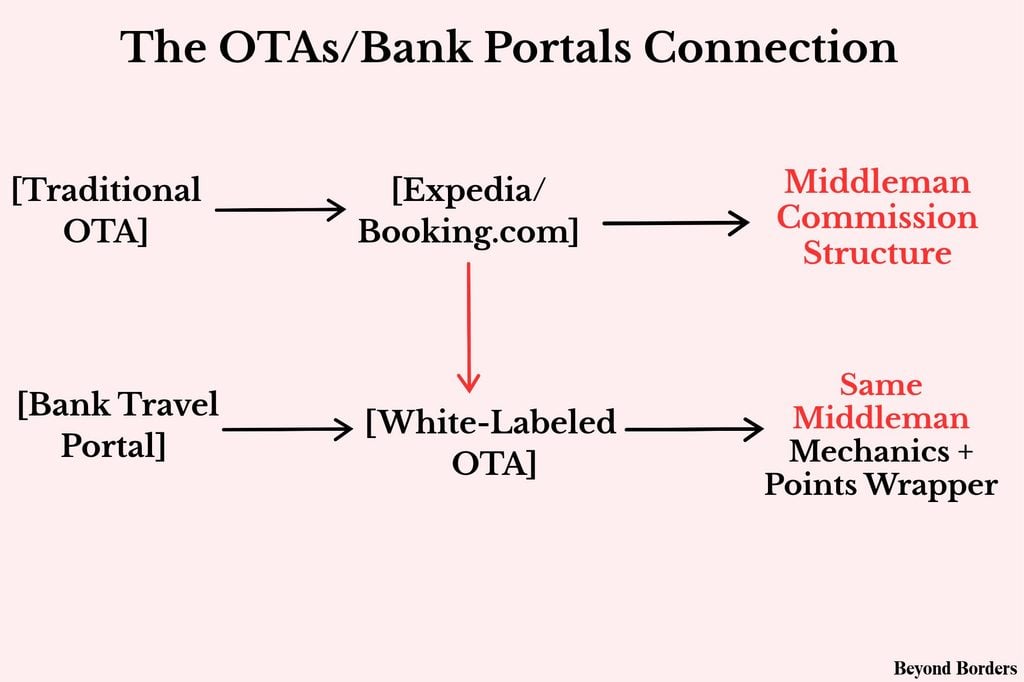
When you understand that bank portals share the exact same underlying mechanics as traditional OTAs, your reward strategy shifts. You stop treating the portal as a default search engine and start leveraging the card’s true superpowers: point portability and direct booking protections.
3. Flexible Points as Currency, Not Portal Coupons
The true value of premium rewards cards (like the Chase Sapphire® series, Amex Platinum®, or Capital One Venture X®) is not their white-labeled booking portals. The real power lies in point portability.
When you hold flexible, transferable points, you are neither locked into a single airline or hotel brand, nor are you forced to spend points like cash inside a middleman portal. If cash ticket prices spike, you can instantly move points 1:1 directly to major loyalty partners:
- Airline Alliances: Transferring bank points to Air Canada Aeroplan (Star Alliance), Air France/KLM Flying Blue (SkyTeam), or British Airways Avios (Oneworld) allows you to bypass inflated portal cash rates. You can book an international $4,000 Business Class seat for 70,000 transferred points direct with the operating carrier instead of spending 300,000+ points inside a bank portal.
- High-Value Hotel Partners: Transferring Chase Ultimate Rewards 1:1 to World of Hyatt, for example, often yields 2.0+ cents per point in value at luxury properties, far exceeding the standard 1.0 to 1.25 cents fixed portal rate.
A Note on “Sub-Optimal” Bookings
Remember that flexibility goes both ways. Just because a bank card has a high-profile transfer partner like Hyatt doesn’t mean you are forced to stay exclusively at Hyatt properties for every trip under the sun. Maximizing points shouldn’t mean turning your vacation choices into a second job.
If a boutique independent hotel, an independent bed-and-breakfast, or a non-partner hotel fits your exact travel style or location better, it is perfectly okay to pay cash or use a portal credit (going back to what I said above under “Where OTAs and Portals Deliver Real Value”). The goal is to be wise about your overall volume—saving your high-leverage point transfers for expensive, high-value stays while keeping the freedom to book whatever hotel actually suits your trip when the math calls for it.
4. Built-In Travel Protections for Direct Bookings
Here is the best-kept secret of premium travel cards: you don’t need to book through the bank’s portal to get their top-tier travel insurance.
When you book directly on an airline or hotel website and pay with a premium travel rewards credit card, you get the best of both worlds: direct reservation control plus built-in insurance protections that standard debit cards or direct bank transfers simply don’t offer:
- Primary Auto Rental Collision Damage Waiver (CDW): Covers collision damage or theft without requiring you to file a claim with your personal auto insurance policy first (offered on cards like Chase Sapphire® series and Capital One Venture X®).
- Trip Delay and Cancellation Insurance: Reimburses non-refundable expenses, lodging, and meals if your trip is canceled, interrupted, or delayed due to weather, mechanical failure, or illness.
- Lost and Delayed Luggage Reimbursement: Provides daily allowances for essential toiletries and clothing if the airline misplaces your bag.
5. What You Need to Know Before Applying
Understanding this middleman connection brings us full circle to Part 1 of this series: The Truth About Credit Card Rewards and Travel Influencers.
The travel industry wants consumers to view credit card portals as simple, one-click travel engines. On social media, creators frequently promote credit card portals as the easiest way to book “free travel” with points—a narrative driven by a lucrative financial pipeline:
- High Affiliate Commissions: Credit card issuers pay creators substantial affiliate payouts (often $100 to $200+ per approved application) to feature premium cards.
- Glossing Over Distribution Realities: Short-form content thrives on simple headlines (“How I booked a $1,000 hotel for $0 using my card!”), while omitting the hidden 10% to 30% portal markups, high annual fees and minimum spending requirements to get sign-up points, lost loyalty nights, and ticket ownership hand-offs.
Before applying for a travel rewards card to use its booking portal, run through three fundamental questions:
- Am I paying an inflated rate to earn bonus points? Always cross-check the hotel or airline’s direct “Member Rate” before booking through a bank portal.
- Does the annual fee fit my organic spending? Never alter your baseline budget or force portal bookings just to “break even” on a high annual fee credit card.
- Am I willing to learn 1:1 transfer mechanics? Transferring flexible bank points directly to airline loyalty programs (and utilizing global airline alliances) yields far higher point valuations and keeps your ticket directly with the airline.
When you view OTAs and travel portals for what they truly are—tools to be used strategically rather than default booking engines—you protect your loyalty perks, avoid middleman markups, and ensure your travel rewards work for you.
FAQs: Booking Direct vs Third-Party/OTA
Conclusions: Taking Back Control of Your Travel Strategy
Uncovering the inner workings of online travel distribution isn’t about avoiding travel portals or third-party sites out of fear. It’s about stripping away the marketing facade to see these tools for what they truly are: commercial booking engines with built-in trade-offs.
When you understand the B2B mechanics operating behind the scenes, the choice of how to book stops being about chasing shiny point multipliers and becomes a strategic decision:
- When you choose an OTA or bank portal, you trade ticket ownership, loyalty credits, and direct customer support in exchange for convenience, package bundling, or fixed point redemptions.
- When you choose to book direct, you retain direct reservation control, protect your loyalty status, and ensure that if things go wrong on travel day, the front desk or gate agent has the power to help you on the spot.
The New Rules of Engagement
Winning the travel rewards game doesn’t require you to abandon your credit cards or ignore online travel agencies. It simply requires a new ruleset:
- Treat portals as secondary option, not default search engines. Always check direct “Member Rates” and run the true rate math before assuming a portal point multiplier gives you the best deal.
- Decouple earning points from spending points. Use your travel cards for their high earning rates, built-in trip insurance, and 1:1 point transfers—not because you feel obligated to spend every point inside a bank’s white-labeled storefront.
- Match booking means to trip risk. High-stakes, multi-leg international flights and major chain hotel stays belong in direct booking; low-risk domestic legs and boutique independent hotels are where OTAs and portal statement credits shine.
The travel industry spends billions driving consumers toward middleman portals and white-labeled storefronts. But once you look past the social media feed and understand how travel distribution actually works, you take the driver’s seat—ensuring your money, your points, and your hard-earned vacation days are fully protected.