How to Ride the NYC Subway At a Glance:
Mastering the New York City subway system is simpler than it looks if you understand a few foundational rules. Use this strategic breakdown:
- How to Pay: MetroCards have been phased out. The easiest and fastest way to pay is OMNY, the contactless payment system. You can simply tap your smartphone (Apple Pay/Google Pay), contactless debit/credit card, or smartwatch directly at the turnstile reader for the standard $3.00 fare.
- Knowing Which Way to Go: Before you swipe or tap, look closely at the entrance signs. You must know whether you are heading Uptown/Bronx, Uptown/Queens, or Downtown/Brooklyn. If you go through the wrong turnstile, you will have to exit and re-pay!
- Express vs. Local Trains: This is the classic rookie mistake. Local trains (white bullets on the map) stop at every single station. Express trains (bullet symbols with black backgrounds or specific letters/numbers) skip stations.
- My top tip: Always double-check the signs on the platform (running parallel to the tracks) to see if your train is running local or express before stepping inside. The electronic signs you will see directly on the platform do not list which trains are local vs express.
- My Navigation App Tip: I always recommend using the myMTA app and Google Maps or Transit for real-time tracking and precise train delays. Refer to my guide on the best apps for NYC subway navigation to help you navigate the subway, including reliable offline maps when you are underground.
Introduction
Using the New York City Subway is the quickest way to get around the city, and I have incorporated it into my 5-day NYC itinerary and my 1-day NYC itinerary. However, I know the subway can look daunting and overwhelming due to the number of lines and stations, but the good thing is that the more you use it, the easier it will be to understand and navigate. Whether you are visiting New York City or have just moved there, here is your ultimate guide on how to use the NYC subway with essential tips to help you learn how the city’s subway system works.
Jump to my Quick-Reference FAQs ↓ at the bottom of this guide if you have a specific question!
Quick Guide: Using the NYC Subway
| Feature | The Rule/Cost | Pro-Tip |
| Fare | $3.00 per ride | OMNY caps at $36/week (rides are free after 12). |
| Payment | Tap & Go | Use Apple/Google Pay or a Contactless Credit Card. |
| Schedule | 24/7/365 | Check the myMTA app after 10pm for service changes. |
| Transfers | Free | Subway-to-Bus transfers are free within 2 hours. |
How to Ride the NYC Subway with OMNY: Step-by-Step
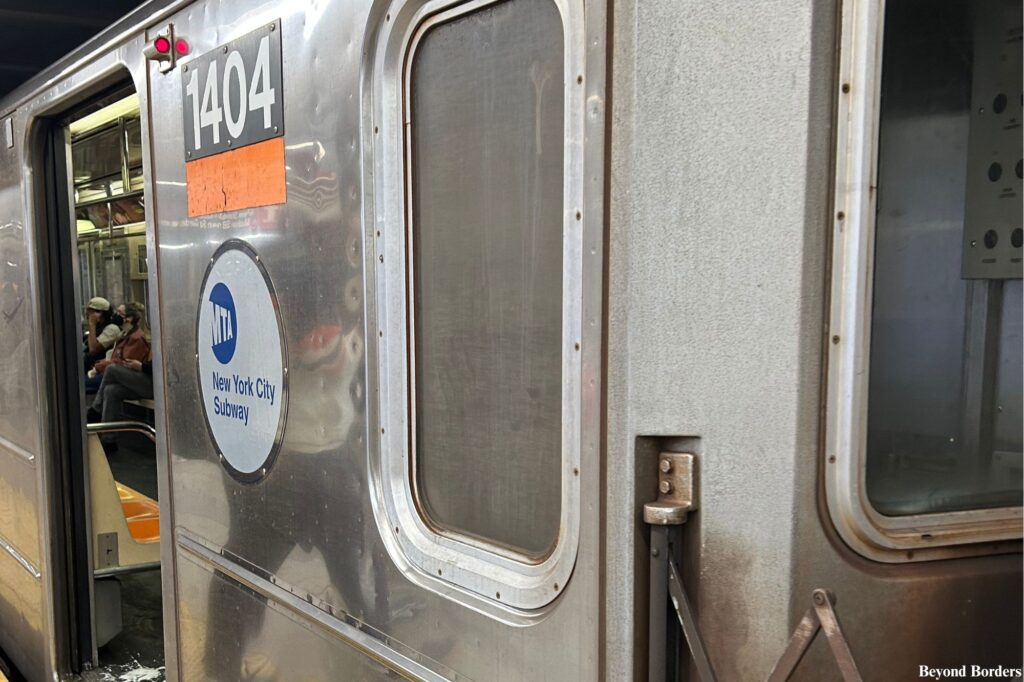
Don’t just follow the colors! Look at the letters and numbers. In NYC, the “Blue Line” has three trains (A, C, E) that serve completely different parts of the outer boroughs. Always check the letter/number on the side of the train before you step inside!
Step 1: How to Choose the Correct Entrance (Finding your Train)
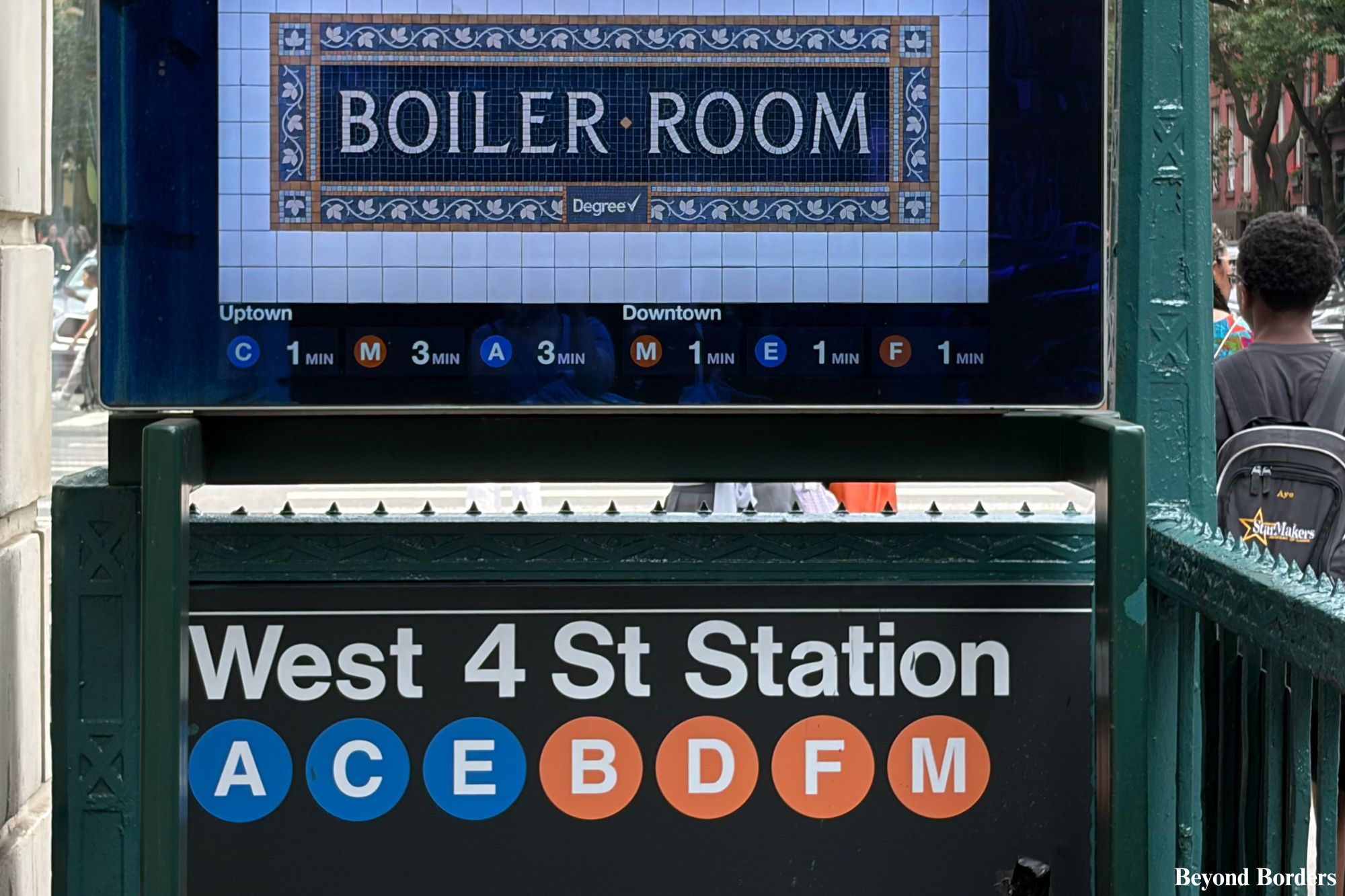
- If the globe at the entrance is green: The station entrance is open 24/7.
- Check the sign: Look for “Uptown/Queens” or “Downtown/Brooklyn” before you go down the stairs. NOTE: If you are at a “Downtown-only” entrance and need to go Uptown, you must cross the street to the opposite entrance. At some (not all) subway entrances, you can walk across underground to get to the opposite entrance.
Step 2: How to Pay Using OMNY Contactless at the turnstile)
- Have your contactless card ready, tucked in a pocket, before you get to the turnstile!
- Pull up your digital wallet (Apple/Google Pay) or grab your contactless card.
- Tap the OMNY screen at the turnstile.
- Wait for the “Go” signal and walk through.
Pro-Tip: The “Double-Tap” Rule
If you use OMNY, you can tap up to 4 people on the same card/phone, but only the first person’s ride counts toward the 12-ride free limit.
Step 3: How to Decide Between Local and Express Platforms
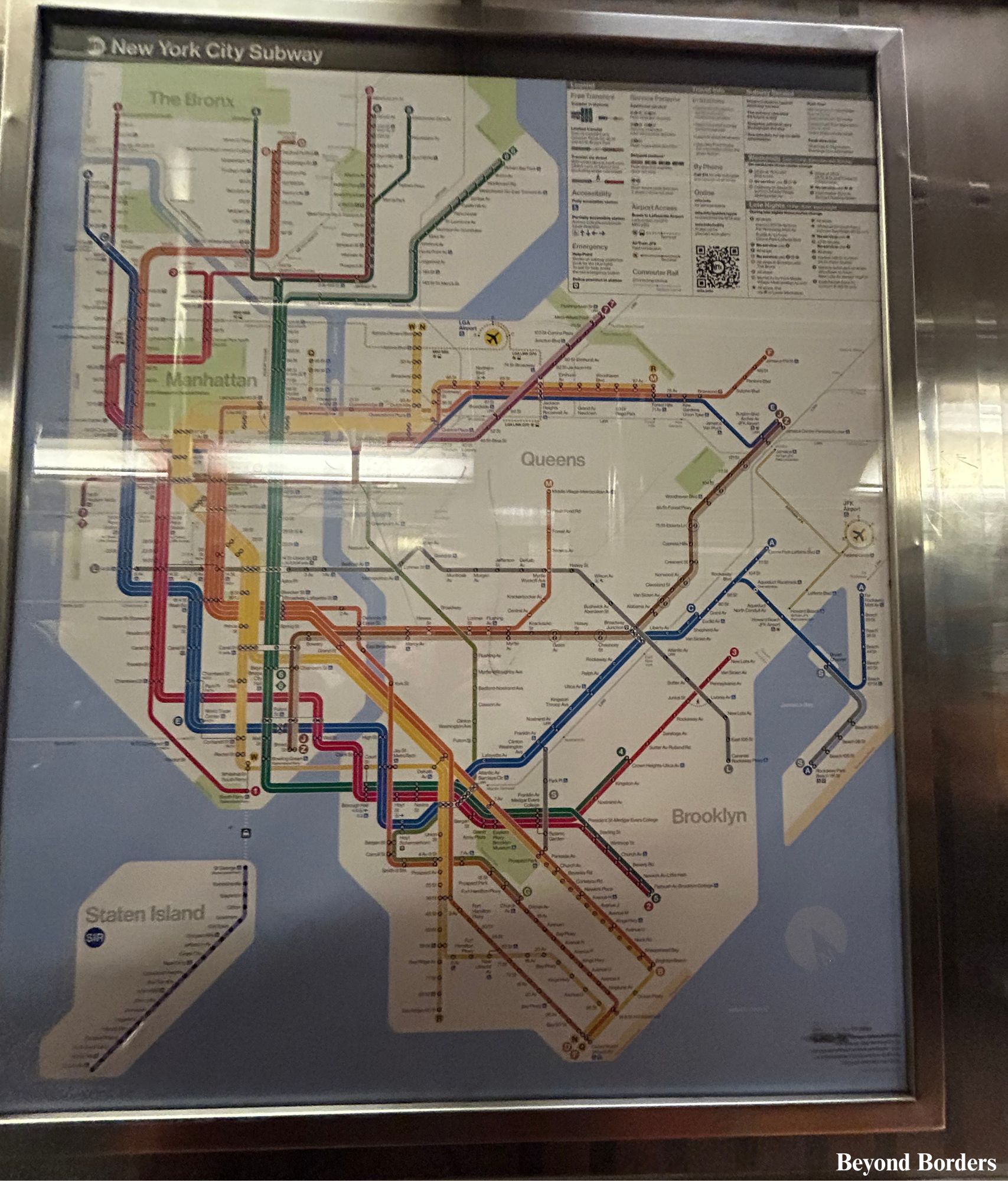
- The Dot Rule: Look at the subway map. Black Dot = Local trains only. White Dot = Express and Local stop here.
- The Circle vs. Diamond:
- Circle Train: It’s stopping at every single station.
- Diamond Train: It’s a rush-hour express–check the side of the train before boarding!
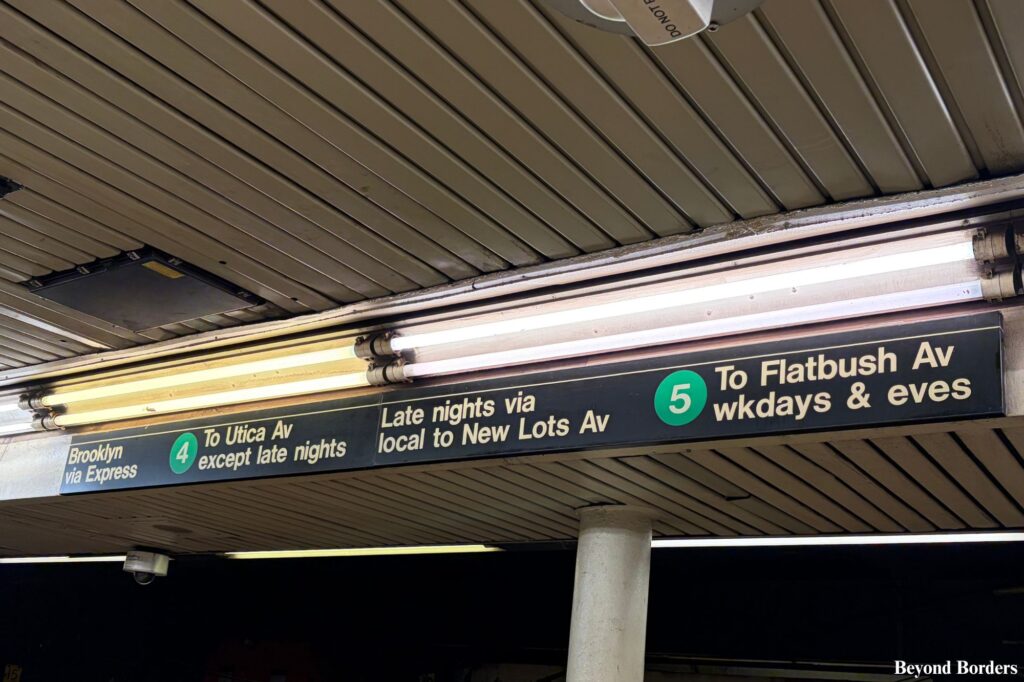
- Sign on the Platform: Check the sign hanging above the platform. Running parallel to the tracks, it indicates the train line, its service type (local or express), and late-night stop details.
My Insider Advice:
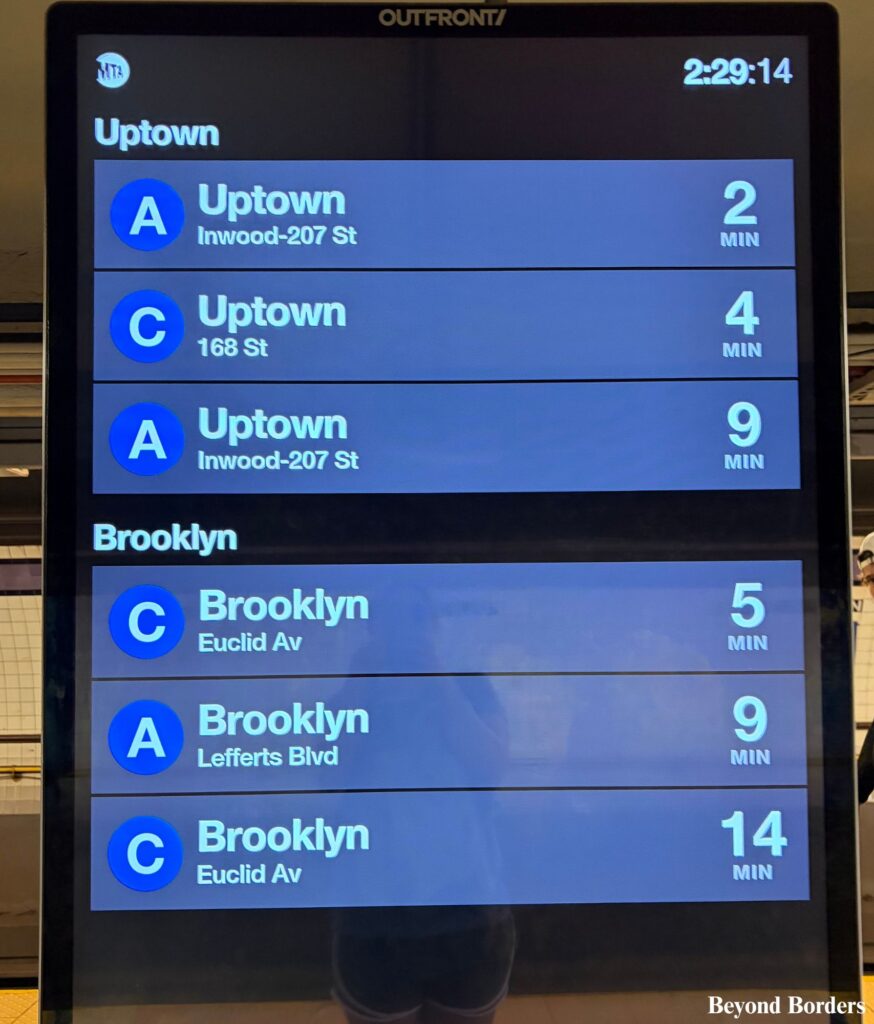
The electronic signs you see directly on the platform list trains that stop at the station, their termini, and how close they are to the station (e.g., 5 minutes away), but they do not list which trains are local vs express.
Step 4: How to Practice Proper Boarding Etiquette to Ride like a Local)
- Step aside: Stand to the left or right of the doors to let people off first.
- Move to the center: Don’t hover by the doors; move into the middle of the car to avoid crowding.
- When on the train, sitting or standing, take off your backpack to make more room for others to sit and/or walk past.
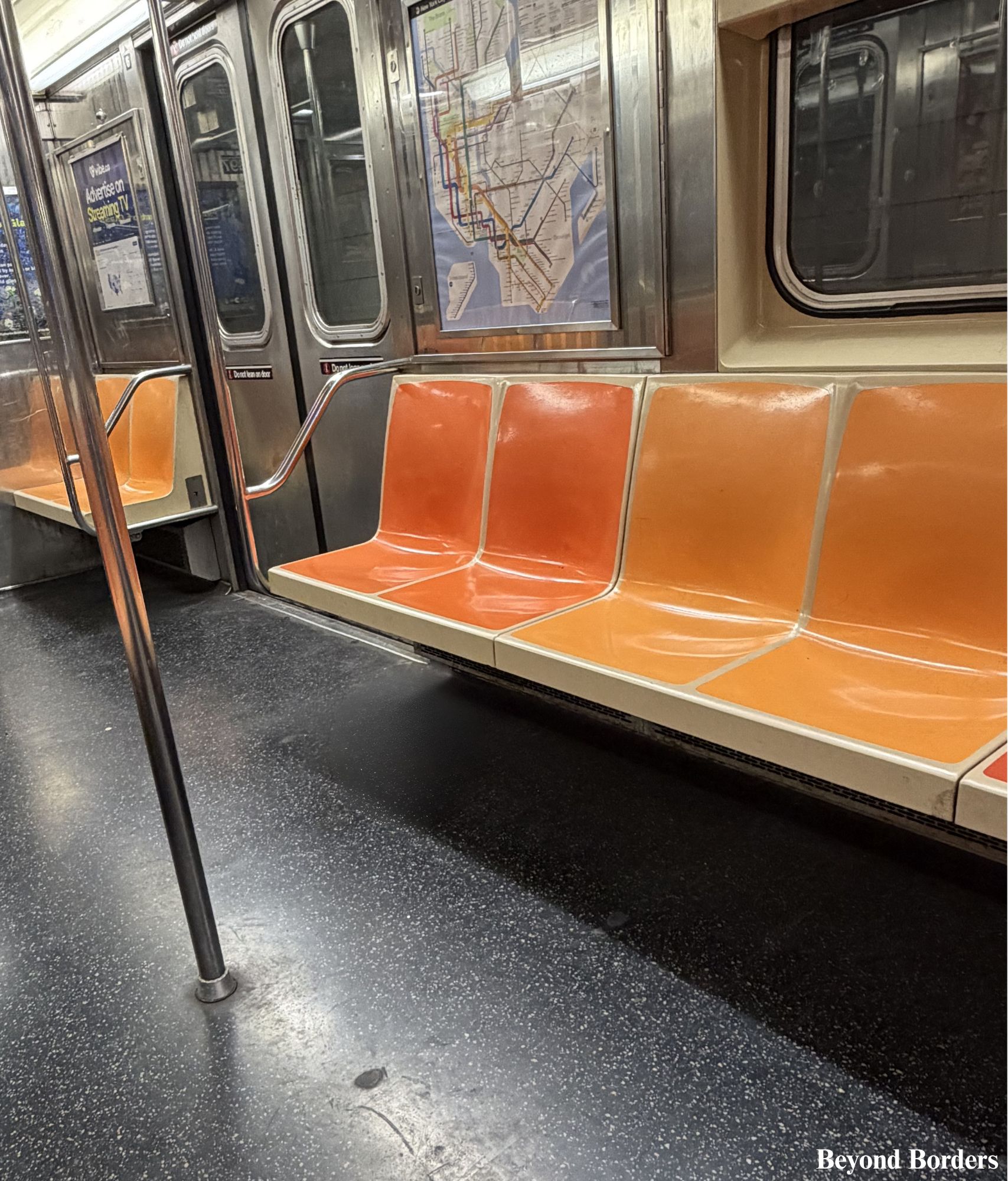
- The “Empty Car” Warning: If one car is empty on a crowded train, do not enter. There is likely a smell or a broken AC. Follow the crowd to the next car.
How to Understand NYC Subway Colors and Lines
| Color | Label | Route |
| Green | 4, 5, 6 | Lexington Ave (East Side Manhattan) |
| Red | 1, 2, 3 | 7th Ave (West Side Manhattan) |
| Blue | A, C, E | 8th Ave (Far West Side) |
| Yellow | N, Q, R, W | Broadway (Heart of Times Square) |
How to Tell the Difference Between Local and Express Trains
| Color | Label | Local or Express? (In Manhattan) |
| Green | 4, 5 | Express |
| Green | 6 | Local |
| Red | 1 | Local |
| Red | 2, 3 | Express |
| Blue | A | Express |
| Blue | C, E | Local |
| Yellow | N, Q | Express |
| Yellow | R, W | Local |
How to Navigate NYC Subway Weekend and Late Night Changes
**Between 10:00pm and 6:00am, the subway routes change.**
When on a subway platform or walking through the subway, you will see signs that say something like “Late Nights take 2 to Times Sq-42 St for 3” and the same for weekends. In New York City, subway trains generally transition to running local at night, typically starting around 10pm to midnight. The official “late night” service period for the NYC subway is usually from 12:00am (midnight) to 6:30am daily. During this time, many express trains convert to local service.
While midnight is the official start of late-night service, some changes and lines may begin running locally as early as 8pm or 10pm, especially if there’s construction being done on the express tracks. The shift to local service at night is primarily due to reduced passenger demand and to allow for track maintenance and repairs on express lines when they are less busy.
Step-by-Step for Late Nights/Weekends
- Open the MYmta app.
- Look for “Service Alerts” (Yellow/Red icons).
- If your express train is running local, add 20 minutes to your travel time.
- You will also notice service changes put up by MTA employees on the columns on the subway platform when waiting for a train.
How to Use NYC Subway Shuttle Services (S)
Shuttles are short, high-frequency routes designed to connect major transit hubs or provide service to specific neighborhoods that aren’t on a main line. If you choose to take a shuttle, it will most likely be the 42nd Street Shuttle.
| Shuttle | Route |
| 42nd Street Shuttle | Runs local between Times Square and Grand Central Terminal |
| Franklin Ave Shuttle | Runs local, connects several lines in Brooklyn (the C, 2, 3, 4, 5, and Q) |
| Rockaway Park Shuttle | Runs locally within the Rockaways in (southern) Queens |
How to Navigate NYC Subway Rush Hour
Rush hour on the NYC subway generally occurs between 6:30am to 9:30am and 3:30pm to 8pm during the week. This is when you will see the large crowds on trains, both locals and tourists. Peak times when the trains are even more crowded are between 7:00am and 9:00am and between 4:30pm to 7:00pm.
How to Get to Top NYC Attractions by Subway
If you are at 42nd St-Times Square/Port Authority Bus Terminal (PABT), follow these routes for the fastest trip to get to these attractions:
| Your Destination | Take This Train | Exit At… |
| 9/11 Memorial and Museum | E | World Trade Center |
| Central Park | A, B, C, or D | Columbus Circle |
| Brooklyn Bridge | 4 or 5 | Brooklyn Bridge–City Hall |
| Rockefeller Center | B, D, F, or M | 47-50th Sts |
| Metropolitan Museum of Art | 4, 5, or 6 | 86th St |
How to Get to JFK and LGA Airports Using the Subway
For a full breakdown of the different ways to get to either JFK or LGA airports from Manhattan using the subway, read my guide on how to travel from Manhattan to JFK and LGA. Here is a quick breakdown:
GOAL: JFK Airport ✈️
- The “I’m in a Rush” Route (Fastest):
- Action: Take the LIRR (Long Island Rail Road) from Grand Central or Penn Station to Jamaica (Queens).
- Transfer: Take the AirTrain to your terminal.
- Cost: Approx. $14–$16 total ($5.25 (off-peak) or $7.25 (peak) for LIRR “CityTicket” + $8.75 AirTrain).
- Time: 35–45 minutes.
- The “Budget Traveler” Route (Cheapest):
- Action: Take the Downtown E train (Blue) to Sutphin Blvd-Archer Ave.
- Transfer: Hop on the AirTrain to your terminal.
- Cost: Approx. $11.75 total ($3.00 Subway + $8.75 AirTrain).
- Time: 60–75 minutes.
- The “I Have Heavy Bags” Route:
- Action: Book a Rideshare (Uber/Uber Shuttle/Lyft).
- Cost: Approx. $70–$110+ (depends on traffic and price surge).
My Insider Advice:
In 2026, traffic into JFK can be brutal due to ongoing terminal construction. Always check the “LIRR” path first; it bypasses the Van Wyck Expressway traffic!
GOAL: LaGuardia Airport (LGA) ✈️
- The “Standard” Route:
- Action: Take the F, M, R, or 7 train to 74 St-Broadway/Jackson Heights.
- Transfer: Look for the yellow signs for the Q70 “LaGuardia Link” Bus.
- Cost: $3.00 total. (The Q70 bus is FREE, and your subway transfer is included).
- Time: 45–60 minutes.
- The “Uptown” Route:
- Action: Take the A, B, C, D, 2, or 3 to 125th St.
- Transfer: Catch the M60-SBS Bus across 125th St directly to LGA.
- Cost: $3.00 total (one OMNY tap).
- Time: 45–60 minutes.
Reminders
- The AirTrain is completely safe. It might sound overwhelming due to JFK’s size, but as long as you follow directions, you’ll be fine! To read more about the AirTrain, visit the official website.
- OMNY/Contactless payment is king: You no longer need a MetroCard. Just tap your phone or contactless credit card at the subway turnstile, on the M60 bus, and even at the JFK AirTrain gates.
- The “CityTicket” Hack: If taking the LIRR to Jamaica (for JFK airport), ask for a CityTicket. It’s a flat discounted fare ($5.25 off-peak / $7.25 peak) for any trip staying within NYC.
- Terminal Check: JFK is massive. Use the free AirTrain to move between terminals, but pay attention to the announcements–some trains go to “Jamaica” and others go to “Howard Beach.” For Midtown, you always want the Jamaica train!
Quick History
The New York City Subway is one of the world’s oldest public transit systems, with the first underground line opening on October 27, 1904. However, elevated train lines in the city existed earlier, with the first operation dating back to October 9, 1863. As I have stated before, the NYC Subway is famous for running 24 hours a day, 7 days a week. It has only shut down completely a handful of times in its history, notably during the September 11th attacks in 2001 and Hurricane Sandy in 2012.
The NYC Subway connects Manhattan, Queens, Brooklyn, and the Bronx (Staten Island is not connected by subway). It has 245 miles (394 km) of routes and 691 miles (1112 km) of railway tracks. Approximately 60% of the tracks are underground, while 40% are above ground.
Accessibility
The NYC Subway is working to improve its accessibility, but it still has a long way to go. As of January 2025, 152 out of all 472 stations are accessible to some extent. The MTA is committed to significantly increasing accessibility; its goal is to make 95% of the subway system fully ADA-compliant by 2055. The primary reason for the low number of accessible stations is that the system was largely built in the early 1900s, long before the Americans with Disabilities Act (ADA) was passed in 1990.
FAQs: Riding the NYC Subway
Conclusions: Don’t Let The Subway Intimidate You
While the New York City Subway can look confusing at first, it becomes easier to understand the more you use it. I hope this guide takes the stress out of using the NYC subway, helping you feel confident as you explore the city! Remember, if you get lost or feel confused at a subway station and need assistance, seek out an MTA employee, a patrolling police officer, or perhaps a fellow commuter (if they don’t look preoccupied). They can help you get back on track.
Ready to ride like a pro? Once you’ve mastered the mechanics of the turnstile, learn how to maintain situational awareness and stay safe with my guide to NYC subway safety tips for visitors.